


Every fleet has one. A dish that has been bolted to the same roof for two years and has never missed a beat, sitting next to a second unit that has been back for repair three times. The reliable one is not a better dish. It is the one that never travels.
That is the uncomfortable finding when you look at how Starlink Mini units actually fail in mobile fleets. The dish itself is a sealed, solid-state device with no moving parts, and the Mini carries an IP67 rating for dust and short immersion. What damages them is not weather. It is the routine: the same tray, the same toolbox, the same fifth crew that borrows the unit, uses it in the rain and puts it back wet. This guide covers what genuinely fails, how to match a Starlink Mini protective case to the way your dish actually moves, and how to build a kit your crews cannot get wrong.
What Actually Fails on a Starlink Mini in Transit
There is a useful distinction to make before spending anything. A Starlink Mini that stays mounted on a vehicle for weeks has a different risk profile from one that is packed and unpacked every morning. The mounted unit faces debris, hail, sun and vibration. The travelling unit faces impact, crush, dust in the connectors, and human error. Most fleet failures come from the second group, and most of those come from handling rather than from the hardware.
It is also worth being precise about what IP67 does and does not mean, because it is the most commonly misread specification in this conversation. IP67 is an ingress rating: dust-tight, and protected against immersion in water for a short period. It is not an impact rating, a crush rating or a vibration rating. A rating that keeps water out of a sealed enclosure tells you nothing about what happens when a toolbox slides across a tray on a corrugated road. The dish is IP67; the router that ships with it is an indoor unit rated IP54, which is a considerably lower bar and the part most often left loose in a bag.
The Dish Face and the Radiating Surface
The face of a Starlink Mini is a flat phased-array panel, and it is the part that has to stay geometrically true. The array works by controlling the phase of thousands of small elements across that surface. If the panel is bent, dented or has a section of its face delaminated, performance degrades in ways that are hard to diagnose on site and easy to blame on the service.
A toolbox resting on an unprotected dish is the classic version of this. So is a dish stored loose in a tray with a jerry can, or a dish that has been sat on a tailgate while a crew rigs it. None of these produce a dramatic crack. They produce a dish that still connects, but holds the link for shorter periods, or drops it in conditions that used to be fine.
Because that failure is gradual, it rarely gets reported as damage. It gets reported as "the internet is slow out here now", which is a much harder complaint to chase down six weeks after the fact.
Cables, Plugs and Connectors
The single most common preventable failure in mobile use is at the connections rather than the dish. A power plug that is pulled out in a dusty tray, pushed back in with grit on it, and left exposed to overnight condensation will eventually cause voltage instability. With a Mini, that tends to show up as repeated reboots rather than a clean failure, which makes it look like a power supply problem when it is really a dirty contact.
Hardwired installations avoid much of this, which is why they dominate permanent sites. For a dish that moves, the pragmatic answer is to stop unplugging what does not need to be unplugged. Leave the cable connected to the dish and break the connection at an accessible, protected point instead, and keep the dust out of that point with a cover when it is not in use.
Cable routing matters for the same reason. A cable that is coiled tightly around a case handle every day for a year will fatigue at the plug body, and the fault will appear as an intermittent connection that only shows up on rough roads. Coil to a generous diameter, secure the coil so it cannot flop, and treat the plug as the delicate part, because it is.
The Router, the Power Supply and the Loose Bits
The dish gets all the attention, but the parts that fail most often in a shared kit are the ones without a home. The router is an indoor unit and should never be left loose under tools. Power supplies, adapters and cables that live in a bag lose their caps, gain grit and eventually get swapped between units until nobody knows which adapters belong to which dish.
This is an accountability problem as much as a hardware one. In a pool of six units across four crews, the missing piece is usually not lost. It is in another ute, and the crew that needs it will make do with whatever fits. That workaround is where most damage actually starts.
The fix is unglamorous: one container per unit, sized to hold the dish and its ancillaries and nothing else, labelled, and treated as the unit's address. Anything that lives outside that container will go missing within a season.
The dish is not the fragile part. The fragile part is the routine: the same tray, the same toolbox, the same crew that borrows it, uses it in the rain and puts it back wet.
Matching a Starlink Mini Protective Case to How the Dish Actually Travels
The mistake most fleets make is buying one type of protection and applying it to every unit. There are genuinely three different jobs here, and a single product does not do all three well. Getting this right costs less than getting it wrong, because the wrong case gets left in the ute and the dish travels loose anyway.
Start by answering one question for each unit: where does this dish spend most of its time? If the answer is "in the tray, going somewhere", the priority is impact and crush protection. If it is "bolted to a machine or a site shed for six weeks", the priority is debris, hail and sun. If it is "in a bag, on a plane, between depots", the priority is a compact, carry-on-legal, everything-in-one package. The three cases below map to those three answers, and they are not interchangeable.
Ute Tray and Toolbox Transit
For a dish that rides in a tray, the requirement is a rigid shell with closed-cell foam cut to the dish profile. The job of the case is to stop point loads reaching the array and to stop the dish moving inside the case when the vehicle is on corrugated roads for hours at a time. Foam that is too soft lets the unit shift; foam that is cut to fit holds it still.
The Starlink Mini Hard Protective Travel Case is the right shape for this work: a hard shell that survives being at the bottom of a loaded tray, with the dish held in a moulded position rather than rattling around inside a soft bag. Its secondary benefit is that it makes the unit visible and countable, which matters more than it sounds when you are trying to work out which crew has which unit.
Two practical notes for tray use. First, put the case somewhere it will not be used as a step or a workbench, because crews will do both if it is the most convenient flat surface in the tray. Second, do not leave it unsecured. A hard case that slides and hits a tray wall at speed transfers that impact straight into the dish, which is the opposite of what you bought it for.
Mounted and Left in Position on Site
A dish that stays in position for weeks has almost nothing in common with a travelling unit. The threat is not crush, it is the slow wearing effects of the environment: dust driven into the face at speed, hail, UV on the plastics, and debris thrown up by machinery working nearby.
This is where a Starlink Mini Dish Protector Shield earns its place. It sits over the dish face and takes the debris strikes and the hail so the array underneath does not have to. On a site with earthmoving plant working within a hundred metres, that is not a theoretical benefit. The shield is also substantially cheaper than the dish it is protecting, which makes it a consumable item rather than a capital one, and that changes how crews treat it.
The other half of this problem is selection. A dish bolted to a machine that moves across a site has different mounting needs from one on a site shed, and the mount is what determines how much vibration reaches the unit. If you are protecting a dish in position, protect the whole installation and not just the dish face, because a shield over a dish that is vibrating loose on a failing mount solves the smaller half of the problem.
FIFO, Air Travel and Shared Pools
The third job is the travelling pool unit, the one that goes between depots and occasionally on a plane. Here the constraint is not strength but form factor, and the practical question is whether everything the unit needs travels with it in one item that can be carried on.
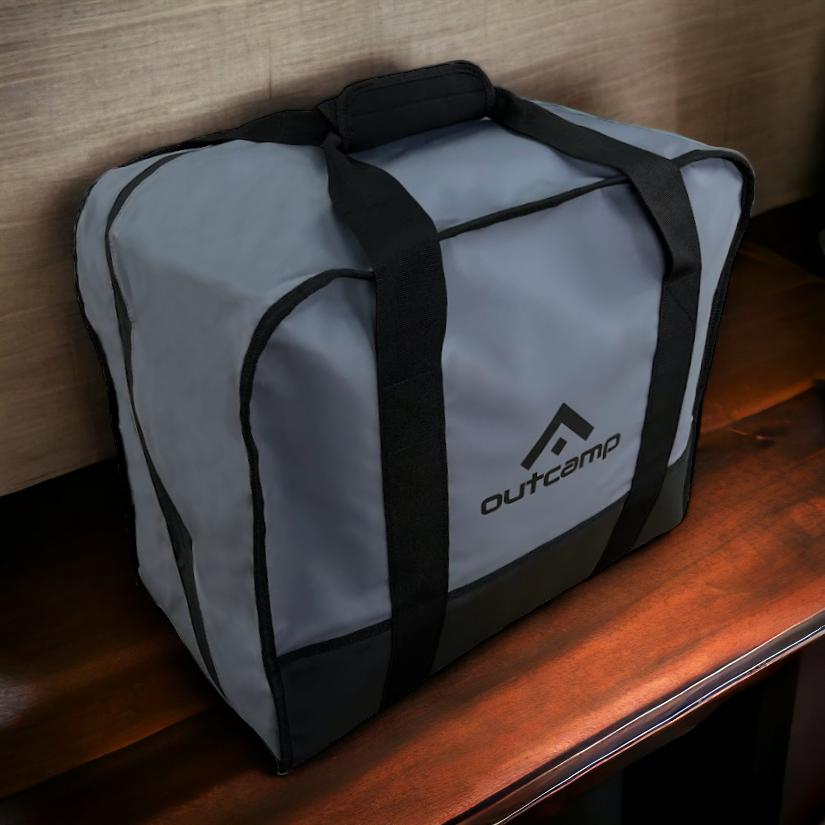
For this, a Starlink Mini Travel Backpack (USB Charging Port & TSA Lock) is a better answer than a hard case, for the simple reason that a hard case that gets checked is a hard case that can be lost. A backpack that carries the dish, the power supply and the cables together, and locks, keeps the unit self-contained. A Starlink Mini Carry Bag suits the lighter version of the same job for a unit that is moving between sites by road rather than by air.
The pool unit also needs the tightest asset discipline, because it is the one most likely to come back missing pieces. If the backpack is the unit, and nothing leaves the backpack, you have solved the majority of the failures this category produces.
Building a Dish Kit Your Crews Cannot Get Wrong
Hardware is the easy part of this. The reason fleets keep having the same conversations about damaged units is that the process around the hardware is vague, and vagueness in a remote setting defaults to whatever is fastest. A kit that is well designed but has no defined home will be dismantled within a month.
The goal is a setup where the correct action is also the easiest action. That means the protection lives with the unit, the unit has one identified location, and the check at handover takes less time than the argument about who had it last. None of that is expensive, and all of it outlasts any individual product decision.
One Kit Per Unit, Labelled
Every unit should have one container, and that container should carry the unit's identifier on the outside in a way that survives dust and sun. The point is not tidiness. It is that a labelled container makes the unit a countable asset, which turns an invisible problem into a visible one.
Inside the container, the contents should be fixed: the dish, its power supply or cable, any adapters that belong to it, and the protection items. If an adapter can be swapped between units, it will be, and you will discover it at the worst possible moment. Where a unit genuinely needs a shared accessory, treat that accessory as its own trackable item rather than a loose part.
Labelling also changes crew behaviour in a way that is worth noting. A unit with a name is treated differently from a unit in an unmarked bag, and the difference shows up in how often it comes back complete.
A Handover Check That Takes Two Minutes
The handover check does not need to be a form. Three questions, asked out loud at the changeover, catch the majority of problems: is everything in the container, is the dish face undamaged, and are the connectors clean and dry.
The third question is the one people skip and the one that causes the most failures. A connector that goes back into the case wet, in a coastal or high-humidity environment, will corrode quietly and produce intermittent faults weeks later. Building a habit of wiping and capping the connector before the case closes is a thirty-second job that removes an entire class of outage.
Recording the check matters less than performing it, but where fleets do record it, the useful data is not pass or fail. It is which units keep coming back with the same issue, because that pattern identifies the crew, the route or the vehicle causing the damage rather than the dish that takes the blame.
Replacing Parts, Not Dishes
The final piece is treating the protection as a consumable. Shields, covers and foam inserts are all cheaper than the dish, and they are all designed to be the part that gives way. A fleet that replaces a shield every second season is spending far less than one that replaces a dish every second season.
That only works if the parts are available and specified. A shield that is not on the shelf when it is needed will not be replaced, and the dish will go back out unprotected. Keep the consumable items specified in the unit's own record so the reorder happens before the failure rather than after it.
It also helps to be honest about what a failure costs. A damaged dish is not an equipment expense, it is a connectivity outage on a site that depends on it, and the second number is usually considerably larger than the first. That framing is what turns protection from an overhead into a line item a site manager will defend.
Frequently Asked Questions
Does a Starlink Mini need a protective case if it is already IP67 rated?
The IP67 rating covers dust ingress and short immersion, which is about water and fine particles. It says nothing about a socket set landing on the dish face or the unit being crushed under a toolbox in a ute tray. Impact and crush damage are the failure modes a case addresses. The dish is rated IP67; the router is an indoor unit rated IP54 and needs more care, not less.
What is the most common cause of Starlink Mini failure in fleet use?
In practice it is not the dish face but the connections and the routine. Power connectors and Ethernet adapters pick up dust and moisture when they are plugged and unplugged on a daily basis, and a cable that is coiled tightly around the case lid eventually fatigues at the plug. A crew-proof kit with a fixed storage position solves more outages than a heavier case does.
Should a Starlink Mini be stored in its case while mounted on the vehicle?
No. A dish that is left in position for weeks on a site should be protected differently from one that travels daily. In position, the risks are debris, hail and sun exposure, so a dish protector shield and a cover do the work. The hard travel case is for transit and for storage between deployments, not for a dish that stays bolted on.
Where to Start
If you are sorting a fleet out, the useful first step is not a purchase. It is separating your units into the three categories above, because a single Starlink Mini protective case applied to every unit will be the wrong answer for at least two of them. A tray unit needs a hard shell. A permanently mounted unit needs a shield and a cover. A pool unit needs one self-contained bag that everything lives in and nothing leaves.
Once that is settled, the products are straightforward: a Starlink Mini Hard Protective Travel Case for the travelling units, a Starlink Mini Dish Protector Shield for the ones that stay in position, and a Starlink Mini Travel Backpack (USB Charging Port & TSA Lock) or Starlink Mini Carry Bag for the pool. All of them are consumable-adjacent items, which means they should be treated as replacement parts with a reorder point, not as one-off capital purchases.
The last piece is the one that does not come in a box. A labelled container per unit and a two-minute handover check will prevent more outages than any single product on this page, because they address the routine that actually breaks the hardware. If your crews are already running a version of that routine, the protection only has to keep up with it. If they are not, the kit is the easy half of the fix and the habit is the half that lasts.




Leave a comment (all fields required)