


Best 12V Camping Fridges for Australian Touring in 2026: How to Choose, Power and Pack the Right Unit
A reliable 12V camping fridge has become as essential to the Australian touring setup as a swag and a decent pair of boots. Whether you are running a week-long loop through the Victorian High Country or spending a month crossing the Nullarbor, the ability to keep food fresh and drinks cold without relying on ice changes the way you travel. No more soggy bread floating in meltwater, no more frantic trips to the nearest servo for another bag of ice, and no more guessing whether last night's leftover snags are still safe to eat.
The 12V fridge market in Australia has matured significantly over the past few years. Compressor technology is more efficient, build quality has improved across the board, and there are now genuinely good options at every price point. But with dozens of brands competing for your attention — from established names like Dometic and Engel to aggressive newcomers like Brass Monkey and Alpicool — choosing the right unit for your rig and travel style takes a bit of homework. This guide walks you through everything you need to know before spending your hard-earned dollars.
Understanding 12V Fridge Types: Compressor, Thermoelectric and Absorption
Before you start comparing models and capacities, it is worth understanding the three main technologies used in portable camping fridges. Each has its place, and knowing the differences will save you from buying a unit that does not suit your needs. The vast majority of serious Australian tourers use compressor fridges, but the other two types still have niche roles worth considering.
Your choice of technology determines not just how cold the fridge gets, but how much power it draws, how it handles extreme ambient temperatures, and how long it will last under the punishment of corrugated outback tracks. Getting this decision right is the foundation of your entire camp kitchen cooling setup.
Compressor Fridges: The Gold Standard for Touring
Compressor fridges work on the same principle as your household refrigerator, using a compressor to circulate refrigerant through a sealed system. They are by far the most popular choice for 4x4, caravan and camping use in Australia, and for good reason. A quality compressor fridge can cool to minus 18 degrees Celsius regardless of the ambient temperature outside, which means it functions as both a fridge and a freezer.
The key advantage for Australian conditions is performance in heat. When the mercury climbs above 40 degrees on a Pilbara afternoon, a compressor fridge simply works harder to maintain temperature. The compressor cycles on and off as needed, drawing more power in extreme heat but always reaching the target temperature. Modern units from brands like Dometic, Engel and ARB use variable-speed compressors that adjust their output based on demand, reducing power consumption during cooler periods and ramping up when the interior warms after you open the lid.
The trade-off is price. A quality compressor fridge starts around $500 for a basic 35-litre unit and climbs well past $2,000 for premium dual-zone models. However, when you factor in the cost of ice over a few years of regular touring — both the ice itself and the fuel burned driving to buy it — a compressor fridge pays for itself faster than most people expect. The reliability and consistent performance make this the only sensible choice for anyone who camps more than a few weekends a year.
Thermoelectric Coolers: Budget-Friendly but Limited
Thermoelectric coolers use a Peltier device to transfer heat from inside the unit to the outside. They are significantly cheaper than compressor fridges, with most models falling between $80 and $250. You will find them at every Supercheap Auto and BCF store, and they work well enough for a weekend at the beach where you just need to keep drinks cool for a day or two.
The limitation is that thermoelectric coolers can only reduce the interior temperature by about 20 degrees below ambient. On a 35-degree day, the best you can expect is around 15 degrees inside the unit — fine for drinks, marginal for dairy, and not cold enough for meat or anything that needs genuine refrigeration. They also draw power continuously with no cycling, which means a steady drain on your battery whether the contents are cold or not.
For short trips in mild weather, a thermoelectric cooler is a cheap entry point. But for anything resembling serious Australian touring — particularly in the warmer months or in the northern half of the country — they simply cannot keep up. Consider them a stepping stone rather than a long-term solution.
Absorption Fridges: The Caravan Three-Way Option
Absorption fridges, often called three-way fridges, can run on 12V, 240V or LPG gas. They are commonly found built into caravans and motorhomes rather than used as standalone portable units. The absorption cycle uses heat rather than a compressor to drive the cooling process, which means they run silently — a genuine advantage if the fridge sits inside your living space.
On 12V power, absorption fridges are less efficient than compressor models and struggle more in high ambient temperatures. Their real strength is the ability to switch to gas when you are parked up without shore power, making them a practical choice for caravan owners who want a built-in solution that works across multiple power sources. If you are looking for a portable unit to slide into a 4x4 or ute, however, a compressor fridge is the better option.
For the remainder of this guide, we will focus primarily on compressor fridges, as they represent the best all-round choice for the portable 12V camping fridge market in Australia.
Choosing the Right Fridge Capacity for Your 12V Camping Setup
Fridge capacity is measured in litres, and the right size depends on how many people you are feeding, how long your trips typically last, and how much space you have in your vehicle. It is one of those decisions where going too small leads to constant frustration, but going too large wastes power and takes up valuable cargo space that could be used for other gear.
The general rule of thumb for Australian camping is to allow roughly 20 litres of fridge space per person for a weekend trip, scaling up if you plan longer stays between resupply points. A couple doing regular long weekends can get by comfortably with a 40 to 50-litre unit. A family of four heading out for a week needs to think about 60 litres or more, or potentially a dual-fridge setup.
Compact Units: 25 to 40 Litres
Compact fridges in the 25 to 40-litre range suit solo travellers, couples on short trips, or as a dedicated drinks fridge running alongside a larger unit. They fit easily on the back seat of a dual-cab ute, inside a canopy, or in the boot of a wagon without dominating the available space. Power draw is minimal — typically 30 to 40 watts when the compressor is running — making them easy to sustain on a modest battery setup.
Popular models in this range include the Dometic CFX3 35, the Engel MT35F-G5D, and the Brass Monkey 36L. The Dometic and Engel units command a premium for their build quality and proven reliability on rough tracks, while the Brass Monkey offers remarkable value for money if your budget is tight. At this size, you are looking at enough space for a few days of fresh food for two people, plus drinks.
The main limitation of compact units is that you will need to shop and restock more frequently on longer trips. If your touring style involves spending a week or more between towns, you will either need a larger fridge or a separate freezer to extend your provisions. That said, for the majority of weekend warriors and short-trip campers, a well-packed 35 to 40-litre fridge is all you need.
Mid-Range Units: 45 to 60 Litres
This is the sweet spot for most Australian touring setups. A 45 to 60-litre fridge holds enough food for a couple on an extended trip or a family of four for a long weekend. It fits comfortably in the back of most 4x4s, ute canopies and caravan boots, and the power consumption remains manageable with a 100Ah lithium battery and a basic solar setup.
Dual-zone models become available at this size, giving you the option to run one compartment as a fridge and the other as a freezer. This is a genuine game-changer for longer trips, allowing you to keep frozen meat and ice cream in one section while fresh vegetables and drinks stay in the other. The Dometic CFX3 55IM even includes an ice maker — a luxury that quickly feels like a necessity after a few hot afternoons in camp.
At this capacity, you should also pay close attention to the external dimensions and how the fridge will sit in your vehicle. A 55-litre fridge that is tall and narrow will fit differently than one that is wide and shallow. Measure your available space carefully, including any fridge slides or mounting brackets you plan to use, and check that the lid or door has room to open fully without hitting the roof of your canopy or drawer system.
Large Units: 65 Litres and Above
If you are feeding a family on a two-week outback trip, running a mobile workshop, or simply refuse to compromise on cold beer availability, a fridge above 65 litres is where you need to be looking. These units hold serious quantities of food and drink, but they also demand more from your power system and take up significant cargo space.
The Engel MT80F and the Dometic CFX3 75DZ are popular choices at the top end, offering genuine dual-zone capability with enough room to keep a family well-fed for a week or more between resupply stops. Expect power consumption in the range of 50 to 80 watts during compressor cycles, which means a 200Ah lithium battery or a robust dual-battery system is advisable if you are running without solar for extended periods.
Weight is another consideration with larger units. A 75-litre fridge loaded with food and drinks can easily weigh 50 kilograms or more, so a quality fridge slide is essential for safe access and to avoid back injuries. Factor the weight of the fridge, its contents, and the slide into your vehicle's payload calculations — particularly if you are running a caravan where every kilogram counts against your aggregate trailer mass.
Powering Your 12V Fridge: Batteries, Solar and DC-DC Charging
Buying the fridge is only half the equation. The other half is making sure you can keep it running without flattening your battery and leaving yourself stranded. A well-designed 12V power system is what separates a comfortable camp from an anxious one, and your fridge is likely to be the single biggest consumer of power in your setup. Understanding the relationship between your fridge, your battery and your charging sources is essential.
The good news is that modern compressor fridges are remarkably efficient. Most quality units draw between 1 and 3 amps per hour on average, depending on the ambient temperature, how often you open the lid, and whether the contents were pre-cooled before you hit the road. A 50-litre compressor fridge running in moderate conditions will typically consume around 30 to 40 amp-hours over a 24-hour period — well within the capability of a single 100Ah lithium battery.
Battery Selection: LiFePO4 Is the Clear Winner
If you are investing in a quality 12V fridge, pair it with a lithium iron phosphate (LiFePO4) battery. The advantages over traditional AGM batteries are substantial and directly relevant to fridge performance. A 100Ah LiFePO4 battery delivers its full 100Ah of usable capacity, compared to roughly 50Ah of usable capacity from a 100Ah AGM battery that should only be discharged to 50 percent. That means a single 100Ah lithium battery gives you the same usable power as two 100Ah AGMs, at a fraction of the weight.
LiFePO4 batteries also maintain a more consistent voltage throughout their discharge cycle. This matters because your fridge compressor runs more efficiently at a stable 12.8 volts than it does as an AGM battery sags down towards 12.0 volts. The result is better cooling performance and lower overall power consumption — your fridge works less hard when the voltage supply is steady.
For most touring setups, a single 100Ah LiFePO4 battery is sufficient to run a mid-sized fridge overnight and through the following day, assuming you are topping up via solar or your vehicle's alternator during the drive. If you run additional loads like lighting, phone charging and a water pump, or if you camp for multiple days without driving, stepping up to a 200Ah battery or running two 100Ah units in parallel gives you comfortable overhead.
Solar Panels: Keeping the Fridge Running While You Explore
A portable solar panel or blanket is the natural companion to your fridge and battery setup. When you are parked up at camp for days at a time, solar is what keeps the battery topped up and the fridge humming without needing to start the engine. In Australian conditions, solar works exceptionally well for most of the year, particularly in the drier inland regions where clear skies are the norm.
For a single fridge running on a 100Ah battery, a 160 to 200-watt solar panel provides enough input to offset the fridge's consumption and slowly recharge the battery during daylight hours. If you are running additional loads or camping in partly shaded spots, stepping up to 300 watts or more gives you greater margin. Folding panels are the most popular choice for portable setups — they pack flat for transport and can be positioned to track the sun throughout the day.
Pair your solar panel with an MPPT charge controller rather than a cheaper PWM unit. An MPPT controller extracts significantly more energy from your panel, particularly in suboptimal conditions like partial shade, low sun angles or high temperatures. The difference in real-world charging performance is typically 20 to 30 percent — that is the difference between a full battery at sunset and an anxious glance at the voltage monitor as the fridge compressor kicks in after dark.
DC-DC Chargers: Topping Up on the Move
A DC-DC charger connects your auxiliary battery to your vehicle's starting battery and alternator, allowing the auxiliary battery to charge while you drive. This is particularly important for modern vehicles with smart alternators, which vary their output voltage in ways that can confuse or undercharge a lithium battery if connected directly. A quality DC-DC charger like the Renogy 40A, REDARC BCDC1250D or Victron Orion Smart manages the charging profile correctly, ensuring your lithium battery receives a full and safe charge every time you drive.
For touring setups, the DC-DC charger is your primary bulk-charging method. A few hours of driving will typically put 40 to 60 amp-hours back into a depleted 100Ah battery, depending on the charger's rated output and your driving conditions. Combined with a solar panel for stationary top-ups, this two-source charging approach means you should rarely, if ever, find yourself with a flat battery and a warm fridge.
Install the DC-DC charger with appropriately sized cabling and a fuse at each end of the run. Undersized wiring is the most common installation mistake, leading to voltage drop and reduced charging performance. For a 25A charger, use a minimum of 6mm² cable for runs up to four metres; for longer runs or higher-output chargers, step up to 8mm² or consult the manufacturer's wiring guide. Getting the installation right once means reliable charging for years to come.
Practical Tips for Getting the Most from Your 12V Camping Fridge
Even the best fridge will underperform if you do not use it wisely. A few simple habits can dramatically improve cooling efficiency, reduce power consumption and extend the life of your unit. Most of these tips cost nothing — they just require a bit of thought before and during your trip.
Experienced Australian tourers treat their fridge as a system rather than an appliance. The fridge, battery, solar panel and charging setup all work together, and small improvements in how you manage each component add up to a noticeably better experience on the road. Here are the habits that make the biggest difference.
Pre-Cool Everything Before You Leave
The single most effective thing you can do to reduce your fridge's workload is to pre-cool both the fridge itself and everything you put in it. Plug your fridge into 240V mains power at home the night before you leave and let it reach operating temperature before you start loading food. Then pack it with items that are already cold from your household fridge or freezer, rather than loading room-temperature groceries and asking the compressor to do all the heavy lifting on 12V.
A pre-cooled fridge packed with cold contents will draw significantly less power over the first 24 hours of your trip compared to one that starts warm. The compressor runs shorter cycles because it only needs to maintain temperature rather than pull everything down from ambient. On a hot day, this difference alone can save 10 to 15 amp-hours — a meaningful chunk of your battery capacity.
For frozen items, consider using your household freezer to freeze meat, meals and even water bottles solid before departure. These frozen items act as thermal mass inside your camping fridge, helping to maintain temperature during periods when the compressor is off and providing a buffer during lid openings. A well-packed fridge with plenty of frozen thermal mass will recover its set temperature much faster than a half-empty one.
Manage Lid Openings and Airflow
Every time you open your fridge lid, warm ambient air rushes in and the compressor has to work to cool it back down. On a 40-degree day, a single lid opening can raise the interior temperature by several degrees in seconds. The discipline of knowing what you want before you open the lid, and getting it out quickly, makes a genuine difference to power consumption over the course of a day.
Organise your fridge contents so that frequently accessed items like drinks and snacks are on top, with items you will not need until dinner packed at the bottom. Some tourers use clear ziplock bags or small containers to group items, making it easy to find what you need without rummaging. A few seconds of organisation at packing time saves repeated lid openings and the power that goes with them.
Ventilation around the fridge is equally important. The compressor and condenser generate heat that needs to dissipate, and if the fridge is jammed into a tight space with no airflow, it will work harder and draw more power. Leave at least 50 millimetres of clearance around the condenser vents — usually on the side or rear of the unit — and more if possible. In a canopy or enclosed space, consider a small 12V fan to assist with air circulation around the fridge.
Protect Your Fridge on the Road
Australian tracks are not gentle on equipment. Corrugated roads, river crossings and rough station tracks subject your fridge to constant vibration and the occasional heavy jolt. A quality fridge slide bolted securely to your vehicle or drawer system is essential — it protects the fridge from sliding around, provides easy access for loading and unloading, and takes the strain off your back when the unit is fully loaded.
Tie-down straps or ratchet straps should secure the fridge to the slide at all times during travel. Even with a slide, an unsecured fridge can shift during heavy braking or on steep terrain, potentially damaging both the fridge and your vehicle's interior. Use purpose-made mounting brackets if your fridge brand offers them — Dometic, ARB and Engel all sell vehicle-specific mounting kits.
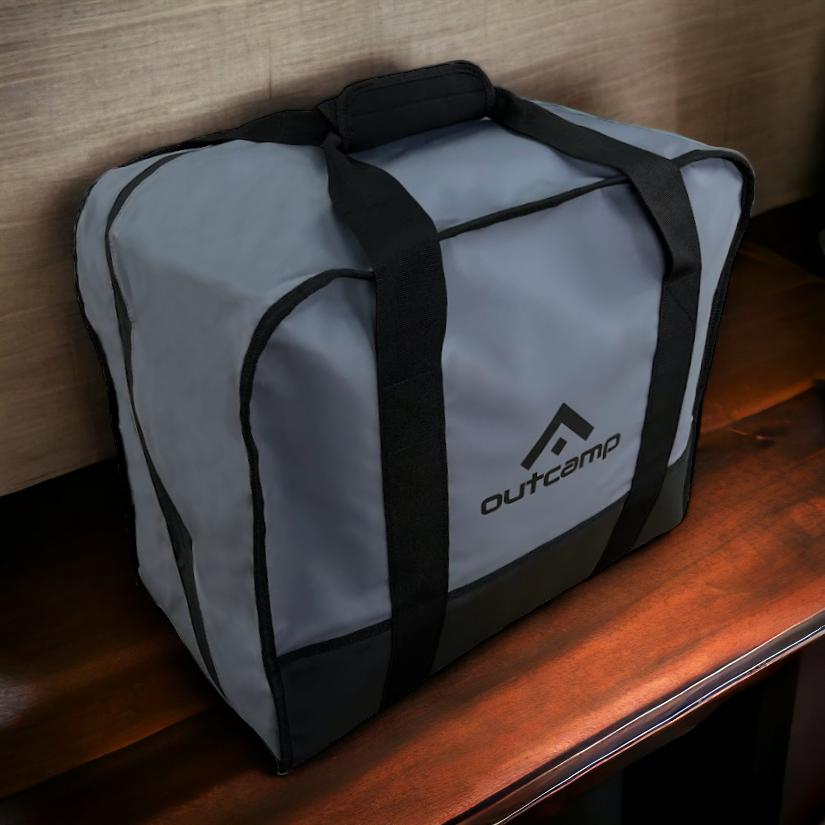
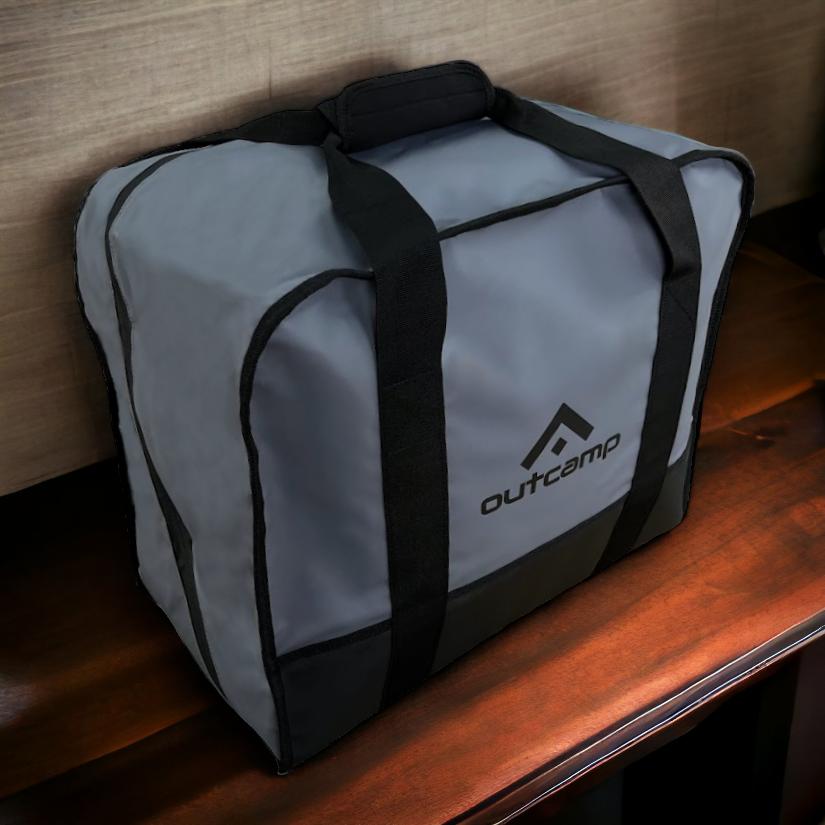
A protective cover or transit bag is worth considering if your fridge lives in an open ute tray or is exposed to dust and weather. Covers also provide a small amount of additional insulation, helping the fridge maintain temperature in extreme heat. At the end of each trip, clean the fridge thoroughly, leave the lid open to air dry, and check the seal gasket for any damage or debris that could compromise the seal on your next outing.
Making the Right Investment for Your Touring Style
A 12V camping fridge is one of those purchases that genuinely improves every trip you take. Fresh food, cold drinks and the freedom to camp for days without worrying about ice are worth every dollar. The key is matching the fridge to your actual needs — your typical trip length, the number of people you feed, the space available in your vehicle and the power system you have or plan to build.
For most Australian campers doing regular weekends and the occasional longer trip, a quality 40 to 55-litre compressor fridge paired with a 100Ah LiFePO4 battery and a 200-watt solar panel hits the sweet spot of performance, portability and value. Those planning extended outback touring or feeding larger groups should look at 60 litres and above, backed by a more substantial power system with dual batteries and a DC-DC charger.
Whatever you choose, pair your new fridge with the right power setup from the start. A fridge without reliable power is just an expensive esky. Browse the Outcamp range of portable power solutions, solar panels and Starlink connectivity gear to build a complete off-grid setup that keeps your food cold, your devices charged and your campsite connected — no matter how far from the blacktop you roam.




Leave a comment (all fields required)