


The Best Portable Solar Setups for 4x4 and Caravan Touring in Australia 2026
Portable solar has matured into a genuinely compelling power solution for Australian off-grid touring, and the 2026 generation of panels, regulators, and power stations represents the best the technology has ever offered. Where early portable solar products often frustrated users with poor real-world output, fragile construction, and incompatible connectors, today's market offers robust, efficient, well-engineered options across a wide range of budgets — from compact folding panels for backpackers to high-output semi-rigid arrays for serious caravan expeditions.
The driving factors behind portable solar's growing adoption in the touring community are straightforward: it generates free power silently, requires no fuel, produces zero emissions, and in Australia's high-solar-irradiance environment, performs exceptionally well for a large portion of the year. A well-chosen portable solar setup can meaningfully reduce or eliminate the need to run a generator or idle your vehicle's engine to recharge your house battery — saving fuel, reducing noise, and allowing you to camp in peace. This guide covers everything you need to build the right portable solar solution for your touring style in 2026.
Understanding Portable Solar Panel Options in 2026
The portable solar panel market divides broadly into three categories: folding fabric-frame panels, semi-rigid monocrystalline panels, and solid framed portable panels. Each category has distinct trade-offs in terms of efficiency, durability, packability, and cost, and the right choice depends heavily on how and where you tour.
Folding solar panels — flexible cells laminated onto a fabric backing with a fold-out aluminium frame or kickstand — remain the most popular choice for 4x4 tourers and caravanners who need portability above all else. Quality folding panels from Enerdrive, Redarc, Hardkorr, and BougeRV typically deliver 120W to 200W per panel and fold to a manageable slab around 55 x 35 x 5cm. They stand on a built-in kickstand and can be angled toward the sun manually, which matters considerably in winter when the sun sits lower in the sky.
Monocrystalline vs Polycrystalline vs PERC Technology
Monocrystalline silicon cells are the dominant technology in quality portable panels in 2026, offering the best efficiency-to-size ratio (typically 20 to 24 per cent cell efficiency) and the best performance in partial shade conditions. Polycrystalline panels — identifiable by their blue, speckled appearance — are less efficient per cell area and have largely been superseded in the premium portable market by monocrystalline, though they still appear in some budget offerings.
PERC (Passivated Emitter and Rear Cell) monocrystalline technology is now standard in most quality portable panels. PERC adds a reflective layer to the rear of each cell, allowing light that passes through to be reflected back through the cell for a second conversion pass — boosting efficiency by 1 to 2 percentage points compared to standard monocrystalline. In practical terms, a 200W PERC panel in a quality folding format will typically deliver better real-world output than a nominally equivalent standard mono panel under the same conditions.
The BigBlue 28W USB Solar Charger is a standout for lightweight day trippers and backpackers who need to charge phones, GPS devices, and small power banks directly from a panel without any additional regulator or storage. For more serious touring setups, 120W to 200W panels with Anderson plug output feeding a dedicated MPPT solar regulator represent the practical sweet spot between portability and meaningful power generation.
Wiring, Connectors and Anderson Plugs: Getting the Basics Right
One of the most common frustrations with portable solar installations is poor connector quality and incorrect cable sizing leading to voltage drop and reduced output. Anderson SB50 connectors — the red or grey two-pin connectors ubiquitous in the Australian 12V touring market — are the standard for portable panel connections and are weatherproof enough for camp use. Ensure your panels, extension cables, and MPPT regulator all use matching Anderson connectors and that cable runs are sized appropriately for the current involved.
A 200W panel in full Australian sun can produce up to 11 amps at 18V — requiring at least 6mm² cable for runs up to about 5 metres to avoid significant voltage drop. Many portable panels ship with undersized cable that clips output noticeably on longer runs between panel and regulator. If you're positioning your panel away from the vehicle to get it into direct sun while the caravan sits in shade — a very sensible strategy — check your cable run length and size up if necessary. The small additional cost of quality cable pays back immediately in improved output.
MPPT Solar Regulators: Maximising Your Panel's Output
The solar regulator sits between your panels and your battery, converting the panel's variable output into the correct charge profile for your battery chemistry. As discussed earlier in the context of fixed roof-mounted solar, MPPT (Maximum Power Point Tracking) regulators are the only logical choice for serious portable setups — their ability to extract maximum power across varying light and temperature conditions typically delivers 20 to 30 per cent more energy into your battery than a PWM regulator from the same panel.
For portable setups where you might be connecting and disconnecting panels regularly, a regulator with a waterproof or splash-resistant enclosure and Bluetooth monitoring capability simplifies daily operation considerably. The Victron SmartSolar MPPT range is the benchmark for quality and feature set — pairing with the Victron Connect app over Bluetooth to give real-time visibility of panel output, battery voltage, and accumulated energy. Redarc's Manager30 MPPT offers similar capability with a strong Australian service network behind it.
Portable Power Stations: The All-in-One Alternative
A significant trend in the outdoor electronics market in 2026 is the growing capability and falling cost of portable power stations — lithium battery banks with integrated inverters, MPPT solar charge controllers, AC outlets, USB-C ports, and 12V outputs in a single self-contained unit. Products from EcoFlow, Jackery, and BougeRV have transformed what's possible for camping without a dedicated 12V system installation.
The EcoFlow Delta 2 and the Jackery Explorer 1000 Plus represent strong mid-range options — both offering around 1kWh of LiFePO4 capacity, 1000W+ AC inverter output, and fast solar charging capability that can replenish from a pair of 200W portable panels in four to six hours of good Australian sun. For caravanners who don't want to commit to a permanent 12V installation, or for supplementing an existing system when demand spikes, a quality portable power station is an elegant solution.
The key specs to evaluate when comparing portable power stations are battery chemistry (LiFePO4 offers 2,000+ cycles versus 500 for standard lithium-ion), maximum solar input (look for 400W or more for practical daily recharging), inverter quality (pure sine wave is essential for sensitive electronics), and operating temperature range — important in Australian summer conditions where ambient temperatures regularly exceed 35°C and the station may be sitting in a hot caravan or vehicle. BougeRV's award-winning T1 Camping Lantern is a good companion product in the BougeRV ecosystem for those already running their portable power stations.
Satellite Internet and Connectivity Power Requirements
One of the most exciting developments driving increased demand for portable solar in 2026 is the widespread adoption of Starlink for off-grid internet connectivity. Starlink's Standard and Mini dishes have transformed remote working and connectivity for Australian caravanners, 4x4 tourers, and grey nomads — but they add a meaningful power draw to any touring system. Understanding this draw and planning your solar accordingly is now an essential step in any touring power system design.
The Starlink Standard dish draws approximately 50 to 75W in steady-state operation, with peak consumption during startup or in cold conditions reaching up to 100W. Running Starlink for six to eight hours per day adds roughly 300 to 600Wh to your daily power budget — equivalent to running a 40L fridge for the same period. For solar-dependent systems, this typically means adding an extra 100 to 150W of panel capacity to keep pace, or accepting a longer daily solar window requirement.
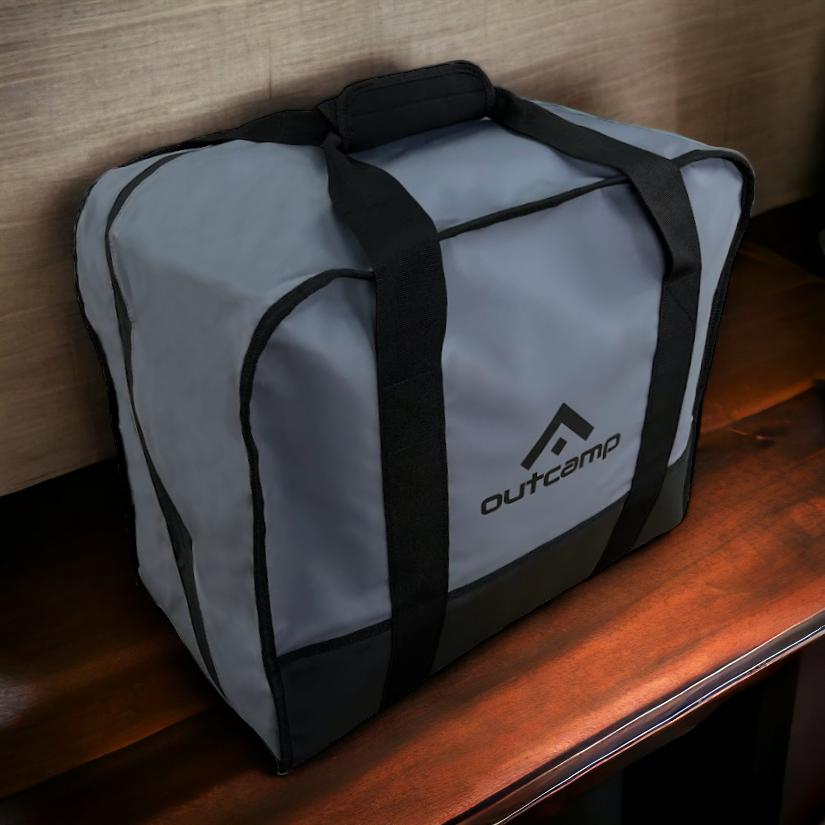
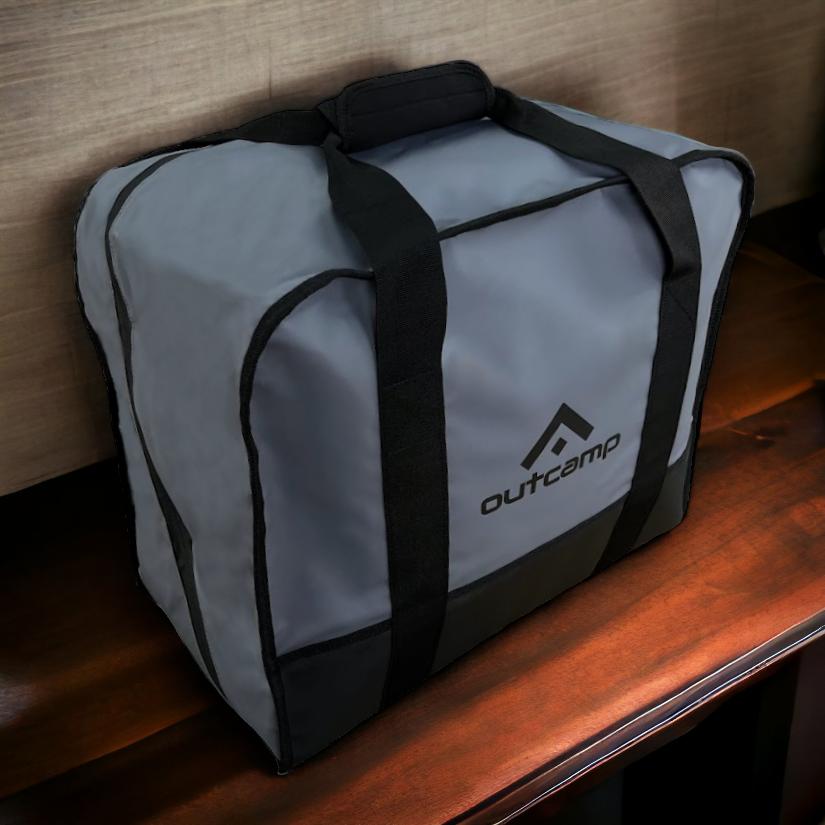
Outcamp specialises in carry bags and mounting solutions designed specifically for Starlink dishes and accessories — protecting your investment from the vibration, dust, and moisture of serious off-road travel. A Starlink setup paired with a quality portable solar system and a lithium house battery is the foundation of a truly self-sufficient mobile workspace that lets you work productively from anywhere in Australia with a clear view of the sky.
Practical Tips for Getting the Most from Portable Solar
The biggest gains in portable solar output don't come from buying more expensive panels — they come from better placement and management of the panels you already have. In summer, partial shade from a single branch or awning edge can reduce a panel's output by 40 to 70 per cent due to the way series-connected cells behave when one is shaded. Position your panels where they'll receive unobstructed direct sun for the maximum number of daylight hours, even if that means running a slightly longer cable between panel and regulator.
Cooling panels perform better than hot ones — panel efficiency drops roughly 0.4 per cent per degree Celsius above 25°C, which can represent a 10 to 15 per cent output reduction on a hot Australian summer day. Placing panels where they receive ambient air circulation beneath them, rather than flat on a hot metal surface, helps maintain output. Flexible panels bonded directly to dark roof surfaces are particularly susceptible to heat degradation — if you're seeing disappointing output from flexible panels after a summer of use, heat cycling degradation may be the cause.
Tilt Angle and Seasonal Adjustment
Australia's latitude range means that optimal panel tilt angle varies significantly by season and location. At Sydney's latitude (34°S), a north-facing panel tilted at 34° delivers maximum annual output — but in winter, tilting to around 55° significantly improves performance as the sun sits lower in the sky. Most quality folding panels include adjustable kickstands that allow you to set a rough tilt angle; taking 30 seconds each morning to optimise the angle for the current season and time of day can improve daily output by 10 to 20 per cent.
In the tropical north — Darwin, Cairns, and surrounding areas — the sun is more directly overhead for a larger proportion of the year, and a low tilt angle or even a flat-lying panel performs relatively well year-round. Understanding your latitude and adjusting your expectations and setup accordingly prevents the frustration of underperforming solar in winter that affects many southern touring setups.
Portable solar is one of the most rewarding investments you can make in your touring self-sufficiency. Once the setup is dialled in and you understand how to position and manage your panels effectively, the free, silent, reliable power it provides becomes one of those things you can't imagine touring without. For Starlink accessories, carry solutions, and power management gear designed for serious Australian touring, explore the full Outcamp range at outcamp.com.au.




Leave a comment (all fields required)