


The Best 4x4 Dual Battery Systems for Australian Touring in 2026
If you spend serious time on the tracks, a single factory battery simply isn't going to cut it. Whether you're running a fridge, a compressor, lighting, a CPAP machine, or charging devices through the night, the demands on your electrical system have never been higher. A properly engineered dual battery system is no longer a luxury — it's the backbone of a capable touring rig.
The good news is that dual battery technology has advanced significantly in recent years. Lithium iron phosphate (LiFePO4) batteries have come down in price, DC-DC chargers have become smarter, and battery management systems now give you real-time visibility over every amp you draw. This guide walks you through everything you need to know about choosing and installing a dual battery system for your four-wheel drive in 2026.
Understanding How a Dual Battery System Works
At its core, a dual battery system separates your vehicle's starting battery from a secondary "house" battery that powers your accessories. The logic is simple — you never want your accessories draining the battery you rely on to start your engine in the morning, especially 300 kilometres from the nearest town.
The two batteries are connected through an isolation device — historically a voltage-sensitive relay (VSR), but increasingly a DC-DC charger (also called a battery-to-battery charger or B2B charger). The isolator monitors voltage and allows current to flow from the alternator to the house battery only when the starting battery is fully charged, preventing either battery from being dragged down by the other.
VSR vs DC-DC Chargers: Which Should You Choose?
Voltage-sensitive relays are the old-school solution. They're simple, affordable, and relatively reliable, but they have a significant drawback — they don't regulate the charge profile delivered to your house battery. This matters a great deal when you're running a lithium battery, which requires a specific multi-stage charge profile to charge efficiently and protect cell longevity.
DC-DC chargers, by contrast, draw power from your alternator and condition it into the correct charge profile for whatever chemistry your house battery uses — AGM, gel, or lithium. They also work with modern vehicles that use variable voltage alternators (which most late-model 4x4s do), something a VSR simply cannot handle reliably. If you're investing in a quality lithium setup, a DC-DC charger isn't optional.
Brands like Redarc, CTEK, Victron Energy, and Enerdrive dominate the Australian market for good reason. The Redarc BCDC series and the Victron Orion-Tr Smart are particularly well regarded for their reliability and smart charging capabilities. Expect to pay between $250 and $600 for a quality DC-DC unit — it's money well spent on a part that sits at the heart of your system.
AGM vs Lithium: The Chemistry Question
AGM (absorbed glass mat) batteries have long been the default choice for 4x4 touring. They're affordable, proven, and can handle deep discharges reasonably well. A quality 100Ah AGM battery will set you back around $200 to $350, and it'll serve you well for several seasons of hard use if you don't regularly discharge it below 50 per cent.
Lithium iron phosphate batteries — commonly called LiFePO4 — are heavier on the wallet upfront but deliver considerably more usable capacity for their weight. A 100Ah lithium battery weighs roughly 12 to 14 kilograms compared to 26 to 30 kilograms for an equivalent AGM. More importantly, you can safely discharge a lithium battery to 80 or even 90 per cent of its capacity without damaging the cells, giving you far more real-world runtime between charges.
Custom Lithium's Ultra Slim XL series — Australia's largest single 12V lithium battery range — has garnered strong attention in 2026 for its form factor and the flexibility it offers for installations in tight canopy or under-seat spaces. For longer expeditions where weight and space are at a premium, lithium has become the default choice for serious tourers. Over a 5 to 10 year lifespan, the cost per cycle of a quality lithium battery often works out cheaper than replacing AGM units every two to three years.
Sizing Your System: How Many Amp Hours Do You Actually Need?
This is the question most people get wrong. The instinct is to buy the biggest battery you can fit, but the smarter approach is to calculate your actual daily consumption and size the battery to give you two to three days of autonomy without recharging. This prevents you from constantly running the battery flat, which shortens lifespan regardless of chemistry.
A 40L fridge running efficiently in moderate temperatures draws roughly 3 to 5 amps per hour on average, which adds up to around 72 to 120Ah over 24 hours. Add LED lighting (1 to 2A), phone and device charging (1 to 2A), and a water pump (intermittent), and a solo traveller or couple can typically manage comfortably on a single 100 to 120Ah lithium house battery with daily alternator charging. Add a CPAP, heated blankets, or a 12V electric blanket and you'll want to think about 150 to 200Ah.
Solar Integration: The Key to True Off-Grid Freedom
An alternator charges your house battery while you're driving, but most serious touring setups are stationary for extended periods — whether you're camped at a remote station, waiting out a flood, or simply working from your caravan for a few days. This is where solar becomes indispensable. A properly sized solar array paired with a quality solar regulator can keep your batteries fully topped up with zero engine running time required.
MPPT (maximum power point tracking) solar regulators are the standard choice for serious setups. Unlike older PWM regulators, MPPT controllers can extract up to 30 per cent more energy from your panels under real-world conditions, particularly in the partial shade or off-angle situations common in bush camping. Brands like Victron, Redarc, and Renogy offer reliable MPPT units that integrate neatly with lithium battery chemistries.
Rigid vs Flexible Solar Panels for 4x4s
Rigid monocrystalline panels mounted on a roof rack are the most efficient option and will last the longest — quality panels carry 25-year performance warranties and degrade at less than 0.5 per cent per year. The trade-off is weight, which can compound quickly when combined with heavy roof rack accessories, and they can't flex around curved rooflines without a custom mounting solution.
Flexible solar panels have improved considerably in recent years, with monocrystalline flexible panels now achieving efficiencies of 22 to 24 per cent — comparable to many rigid options. They can be bonded directly to the roof of a canopy or pop-top caravan, add negligible weight, and maintain a low profile that doesn't compromise ground clearance on challenging terrain. However, they are more susceptible to delamination if bonded poorly or subjected to excessive heat from a dark roof surface, so installation technique matters.
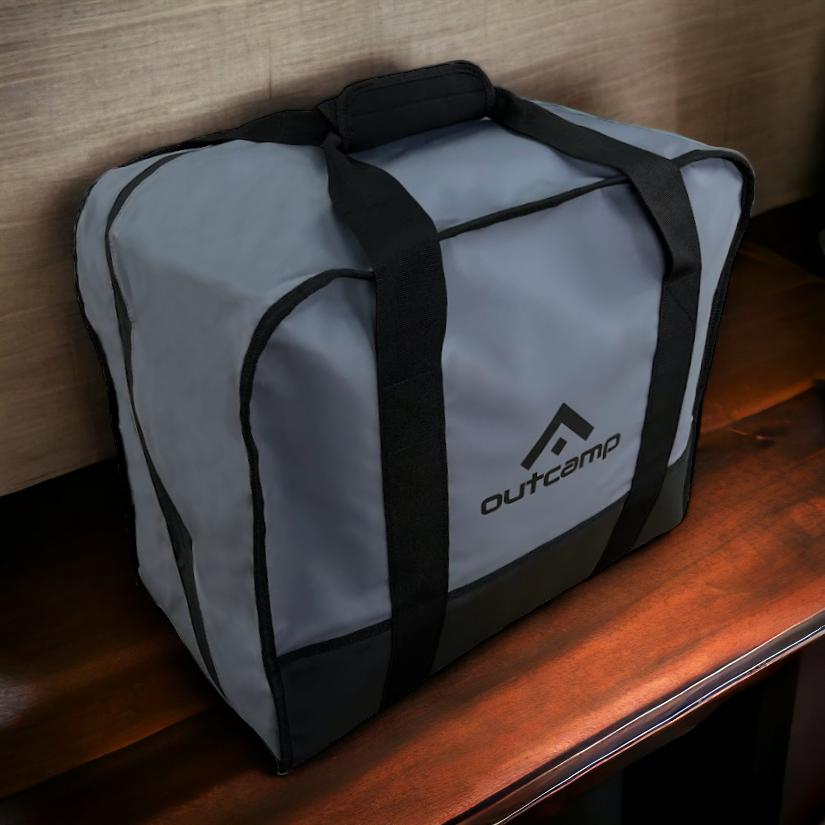
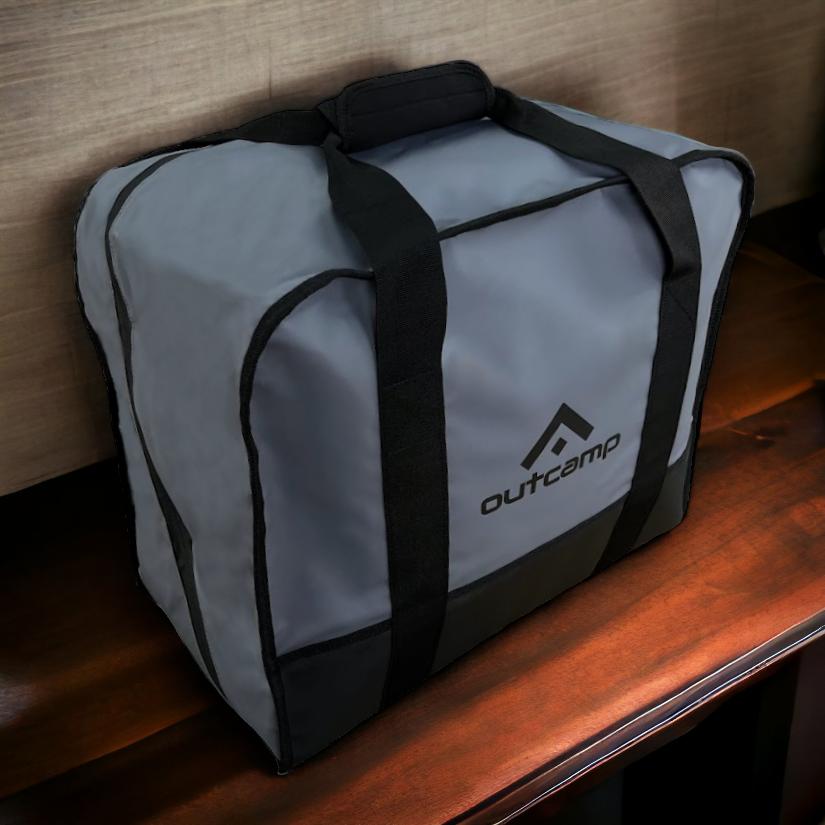
Portable folding solar panels — typically 120W to 200W units — offer the flexibility to position them for maximum sun exposure while the rig stays in shade. This is particularly useful in summer, where a well-positioned folding panel can outperform a fixed roof panel by a significant margin. The Outcamp range of carry bags and storage solutions makes transporting and protecting portable solar equipment on rough tracks far easier.
Battery Monitors: Knowing Your State of Charge
A good battery monitor is arguably the most underrated component of a dual battery system. Without one, you're guessing at your state of charge — and guessing wrong can mean a flat battery at the worst possible moment. A shunt-based battery monitor like the Victron BMV-712 or the Redarc Battery Watch measures every amp flowing in and out of your battery and gives you an accurate readout of remaining capacity, estimated run time, and charge history.
Many modern DC-DC chargers and solar controllers now include Bluetooth connectivity and companion apps, allowing you to monitor your entire power system from your phone without running dedicated monitoring wiring. If you're building a system from scratch in 2026, look for components that can communicate with each other over a common protocol — Victron's VE.Direct and VE.Bus ecosystem is the gold standard for this kind of integrated monitoring.
Some tourers pair their battery monitor with a 12V panel or touchscreen display mounted in the cab — particularly useful in caravans where the battery bank is located in a separate compartment. Knowing at a glance that you're sitting at 85 per cent state of charge with three hours of sun remaining takes all the guesswork out of your power management.
Installation Considerations and Safety
A dual battery system is only as good as its installation. Poor cable sizing, inadequate fusing, and sloppy terminations are the leading causes of electrical fires in modified 4x4s — a sobering thought when you're deep in the scrub and the nearest fire brigade is an hour's drive away. Take the installation seriously, or have it done by a qualified auto electrician.
Cable sizing is dictated by the current load and the length of the run — undersized cable generates heat and causes voltage drop, reducing the efficiency of your charging and potentially causing a fire. As a rule, use the thickest practical cable for your main runs, and always fuse within 300mm of any positive terminal connection. Inline blade fuses are fine for low-current accessories, but ANL or MIDI fuses should be used on heavy current runs of 50A or more.
Where to Mount Your House Battery
The most common locations for a house battery in a dual-cab 4x4 are the engine bay (on a second battery tray), under the rear seat, inside a drawer system in the tub, or in a canopy storage box. Each location involves trade-offs around ventilation requirements, cable run length, accessibility, and the additional weight distribution impact on the vehicle.
AGM batteries can be mounted in any orientation and used in fully enclosed spaces without ventilation concerns. Lithium batteries are similarly sealed and safe for enclosed use, but you should confirm that the BMS (battery management system) inside the unit is rated for the thermal conditions of your chosen mounting location — particularly if the battery is sitting inside an enclosed canopy on a hot Queensland summer day, where internal temperatures can exceed 60°C.
Whatever location you choose, the battery should be secured in a purpose-built tray or battery box that prevents any movement on rough terrain. A loose battery bouncing around in a tub or canopy is a genuine safety hazard. Most quality battery manufacturers offer purpose-designed mounting trays or brackets for their units — use them.
Getting the Most from Your System on the Road
Once your system is installed, a few simple habits will extend battery life and maximise your usable capacity. Avoid discharging your lithium battery below 20 per cent regularly — while LiFePO4 chemistry is tolerant of deep discharge, keeping it above this threshold will significantly extend cycle life. Set your DC-DC charger's low-voltage disconnect threshold accordingly.
On multi-day trips without solar, running the engine for 30 to 60 minutes each morning before the day's activities gives your DC-DC charger time to put meaningful charge back into the house battery — particularly useful in overcast conditions where solar isn't performing. On cloudy or rainy days, being conservative with high-draw accessories like compressors and kettles will see you through with comfortable reserves.
Investing in a well-engineered dual battery system is one of the best upgrades you can make to a touring rig. When your camp fridge is still humming at 7am, the coffee is on, and you know exactly how much power you have left for the day, the value becomes immediately obvious. Whether you're weekend camping or tackling a multi-week 4x4 expedition across Australia, the right electrical setup gives you the confidence to go further and stay longer.
Check out Outcamp's range of accessories designed to complement your off-grid touring setup — from Starlink carry bags to mounting solutions that keep your critical electronics secure on the roughest tracks.




Leave a comment (all fields required)