


The tent-camping power problem
Two days into a bush camp, the phone is flat, the fridge is warm and the lantern has gone dim. Nothing has failed — the setup was just never sized for the job.
Without a caravan or a hard-wired dual battery, everything you run has to come out of one box you carry in the boot. Get the numbers right before you buy, and camping without a van stops being a power rationing exercise.
Quick answer
Add up your daily watt-hours (Wh) first. A 40 L 12V compressor fridge alone burns roughly 1,000 Wh a day, so anything smaller than a 1,000 Wh power station will not keep up. Match storage to that number, then add 120 W or more of portable solar to top it back up, and use the car's alternator while you are driving.
1. Work out what you actually need
Every device has a draw in watts and a run time in hours. Multiply the two and you have watt-hours — the only number that matters when you are comparing boxes.
The Wh maths
A 12V compressor fridge cycles on and off, so its average draw is far lower than its peak. Real-world figures for a 40–60 L fridge sit around 40–50 W averaged across a day, which works out near 1,000–1,200 Wh over 24 hours.
Small stuff adds up quickly: a phone charge is 10–20 Wh, a laptop 50–80 Wh, and each LED lantern only about 20–30 Wh overnight. Two phones, two lights, a laptop and a fridge lands you somewhere between 1.3 and 1.5 kWh a day.
A real camping day
Write your own list before you shop. Weekend trips with no fridge can run happily off a 300–500 Wh unit. Add a fridge and you are in the 1,000–2,000 Wh class, or looking at a battery box with a 100 Ah lithium battery and a DC-DC charger.
Plan for two days of autonomy if you are heading somewhere cloudy. Spring in Australia still throws grey, wet days that cut solar output to a fraction of the rated figure.
2. Choose your storage
There are two honest options for tent and camper-trailer camping, plus one to treat with care.
Portable power stations
Self-contained, quiet and simple: one box with a lithium battery, an inverter for 240 V gear, USB ports and a 12V socket. They charge from solar, the car or a wall socket. Capacity is the only spec that matters for sizing, so compare Wh, not marketing names.
Check the 12V output rating before you buy. Some smaller units limit the cigarette socket to a few amps, which is fine for a fridge but not for anything heavier.
A battery box with a DC-DC charger
Cheaper per watt-hour at larger sizes and easier to expand. A 100 Ah lithium battery gives you roughly 1,200 Wh usable, and a DC-DC charger refills it properly from the alternator while you drive. It is a heavier, more permanent setup that suits camper trailers and long trips.
Generators — with care
Generators have their place, but never inside or beside a tent. Carbon monoxide kills, and it kills quietly. If you use one, run it well away from sleeping areas and downwind, and only where the park or station allows it.
3. Top it back up
Sizing gets you through day one. Charging gets you through the trip.
Solar sizing
For a fridge-running camp, 120 W or more of portable solar is the sensible floor in decent sun. Expect four to six useful hours of charging on a clear day, so angle the blanket square to the sun and move it once or twice during the day.
Shade is the enemy. A panel in dappled shade can drop to a fraction of its rated output, which is why blanket-style panels you can shift around usually beat a panel fixed to the roof of a trailer.
Charging from the car
Driving is free power. A DC-DC charger will push serious current into a battery box on the move, and even a 12V socket charger helps if you are covering big kilometres between camps.
Remember that socket chargers are limited by the plug — most 12V sockets cap out well below a DC-DC unit — so a long day of driving does more for your battery than an hour around town.
4. Make the power last
Habits stretch a setup further than extra capacity does.
Fridge habits
Pre-chill the fridge at home on 240 V, keep it full of cold food and drink, and shade it from direct sun. Airflow around the vents matters more than most people expect, and an insulation cover is cheap insurance in summer heat.
Open it less and open it briefly. Every minute the lid is up is warm air the compressor has to fight for the next hour.
Lighting and charging discipline
Charge phones and laptops in the middle of the day when solar is peaking, not at 9 pm when you are drawing the battery down. Switch to low-draw LED lanterns instead of running an inverter for 240 V lights, and turn the inverter off when nothing needs it.
Real-world tips
- Test the whole setup at home: run the fridge off the station for 24 hours and see what it actually consumes before you trust it on a remote trip.
- Fuse everything. Any 12V lead running from a battery should be protected, and Anderson plugs make connections safer and more repeatable than alligator clips.
- Keep two days of margin for cloudy weather, and consider a small folding panel as a backup rather than one big unit.
- Store power gear out of the sun. Lithium batteries do not like being cooked in a closed ute canopy or a hot tent in January.
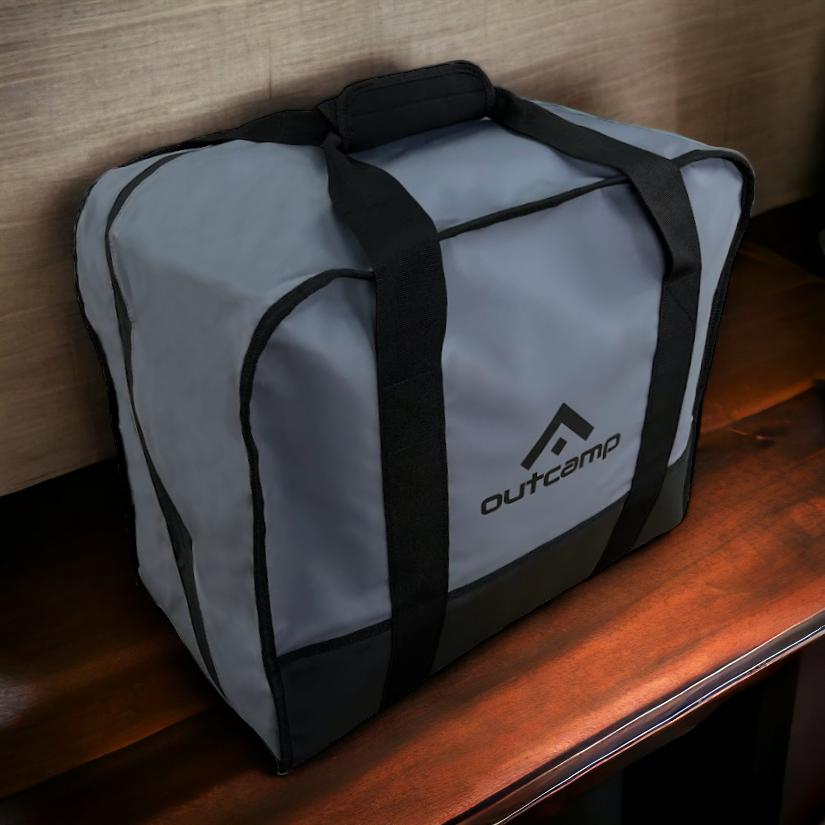
- Label your cables and keep a dedicated bag. Chasing a missing Anderson lead at dusk is a genuine trip-ruiner.
Gear that makes this easier
Cables, chargers and 12V power bits are the difference between a setup that works and one that only works in your driveway. Outcamp's 12V accessories range covers the connectors, chargers and power hardware that keep a tent camp running properly.
Over to you
Work out your daily watt-hours, size the box to match, and let the sun do the rest. If you have a tent-camping power setup that has survived a proper outback trip, share the details in the comments — the best advice always comes from people who have actually run it.




Leave a comment (all fields required)