


Caravan Weight Management: Understanding Tare, ATM and Payload for Safe Australian Touring
Weight is the single most misunderstood aspect of caravan ownership in Australia. Every year, thousands of caravanners unknowingly exceed their vehicle and van's weight limits — not through carelessness, but simply because they never received clear guidance on how the numbers work. Understanding your van's weight ratings is not bureaucratic box-ticking. It is a matter of road safety, insurance validity, and your ability to get out of a difficult situation on a remote track.
This guide breaks down the weight ratings that matter, explains how to calculate your real-world payload, and offers practical strategies for managing what you carry without compromising the comforts that make extended touring worthwhile. Whether you are a first-season grey nomad or a seasoned tourer heading out for the fifth time, getting these numbers right before you leave home is always time well spent.
The Core Weight Ratings Every Caravanner Must Know
Australian caravan weight regulations use specific terminology that trips up many buyers. The three ratings you need to understand before you hitch up are Tare Mass, Aggregate Trailer Mass, and Gross Combined Mass. These are not interchangeable, and confusing them can put you well over legal and safe limits without any obvious sign that something is wrong.
These ratings are set by the manufacturer based on engineering calculations and chassis testing. They are not suggestions. Exceeding them places additional stress on tyres, wheel bearings, brakes, and the draw bar, all of which can fail under sustained overload — particularly on the corrugated outback roads where Australian caravanners spend much of their time.
Tare Mass: What the Van Weighs Empty
Tare mass is the weight of your caravan as it left the factory — including standard fitted equipment, a full fresh water tank in some configurations, and the spare tyre. Importantly, it does not include your personal gear, food, clothing, bedding, tools, solar panels you have added, or any aftermarket accessories fitted after purchase.
The tare mass is the starting point for your payload calculation. If your van has a tare of 2,100 kg and an Aggregate Trailer Mass (ATM) of 2,700 kg, your legal payload — the total weight of everything you add including water, gear, and accessories — is 600 kg. That sounds like a lot until you start adding it up: a full fresh water tank (100 litres = 100 kg), food and groceries for a month (60 kg), clothing for two people (30 kg), tools and recovery gear (25 kg), bedding and towels (20 kg), kitchenware and cooking equipment (15 kg), solar panels and brackets (15 kg). You are already at 265 kg before you have packed a single personal item.
Aggregate Trailer Mass (ATM): The Legal Maximum
ATM is the maximum legal weight of your fully loaded caravan, including all contents. This is the figure that appears on your compliance plate, and it is the figure that applies when your van is unhitched and supported by its own jacks. It is a hard legal limit — not an average load, not a recommendation. Exceeding ATM is illegal under Australian road rules and will void your caravan insurance in the event of a claim.
Many caravanners discover they are over ATM for the first time when they visit a weighbridge. The surprise is usually significant — not because they have been reckless, but because the margin between tare mass and ATM can be smaller than expected, particularly in vans at the smaller end of the market where manufacturers have kept tare low to achieve lower ball weight figures for marketing purposes.
When buying a new or used van, ask the dealer or previous owner for the compliance plate specifications and calculate the available payload before committing. A van with an ATM of 2,400 kg and a tare of 2,050 kg leaves you with just 350 kg of payload. For extended off-grid travel, that is a very tight constraint, and it should influence your purchase decision significantly.
Gross Combined Mass (GCM) and Ball Weight
GCM is the maximum combined weight of your tow vehicle and loaded caravan together. This figure is set by the vehicle manufacturer, not the caravan manufacturer, and it is the limit you must not exceed regardless of whether your caravan's ATM is within spec. If your tow vehicle has a GCM of 6,000 kg and your loaded vehicle weighs 3,200 kg, your maximum trailer load is 1,800 kg — even if the van's ATM is 2,500 kg.
Ball weight is the downward force your van exerts on the tow vehicle's towbar. Australian towing regulations specify that ball weight must fall between 5 and 15 per cent of the van's loaded weight. Too little ball weight causes trailer sway — a dangerous situation at highway speeds. Too much ball weight loads the rear axle of the tow vehicle, compresses the rear suspension, and can cause the front wheels to lift slightly, reducing steering response and braking efficiency.
Managing ball weight is one of the reasons load distribution within the van matters so much. Heavy items — water tanks, canned food, batteries, tools — should be carried low and close to or just forward of the axle. Items placed well behind the axle add to ball weight and contribute to sway. The old rule of 60 per cent of payload forward of the axle and 40 per cent behind remains a solid practical guide.
Practical Payload Management for Extended Australian Touring
Once you understand your theoretical payload, the next step is building a packing system that keeps you within it consistently. Most experienced tourers weigh their van at least once before a major trip — not every time they head out, but after any significant change to what they carry or how the van is fitted. A public weighbridge costs a few dollars and gives you a definitive number rather than a best guess.
Creating a detailed inventory list is the most effective long-term tool for payload management. List every item you carry, estimate or weigh each one, and build a spreadsheet or document you can update each season. This makes it easy to identify where the weight is going and where it can be trimmed when you need to create headroom for a specific trip.
Where Weight Adds Up Fast
Water is the single heaviest consumable most caravanners carry. A 200-litre fresh water tank is 200 kg when full — a significant portion of most payload budgets. For short trips between towns or sites with reliable water access, there is no need to leave home with a full tank. Leaving with half capacity immediately frees up 100 kg that can be used for other gear or simply kept as safety margin.
Tools and recovery gear are another area where weight accumulates quickly, especially for tourers heading off sealed roads. A quality hi-lift jack, snatch straps, traction boards, a folding shovel, and basic vehicle tools can total 30 to 40 kg without difficulty. For the routes and terrain you are actually planning to travel, be honest about which items are essential and which are hypothetical. A well-edited recovery kit suited to your terrain weighs less and is easier to access than a comprehensive kit you carry on principle.
Aftermarket accessories deserve special mention. Solar panels, lithium batteries, bike racks, generator brackets, washing machines, and satellite internet dishes — all of these add weight that did not exist in the van's tare calculation. Keep a running total of everything you have added since purchase, and understand that each addition reduces your legal payload for personal gear and consumables. For connectivity solutions like Starlink, the equipment weight is modest, but the mounting hardware and cable management should be factored into your payload audit.
Upgrading ATM: Is It Possible?
Some caravanners ask whether it is possible to have their van's ATM legally increased. In certain cases, the answer is yes — but it requires engineering certification and is only possible when the van's chassis, axles, tyres, and braking system are rated to support the higher load. Not all vans are candidates for ATM upgrades, and the process involves expense and regulatory paperwork.
Before pursuing an ATM upgrade, it is worth asking whether the more practical solution is adjusting what you carry. In most cases, a thorough payload audit reveals significant weight that can be eliminated or reduced without compromising the touring lifestyle. The psychological attachment to carrying "everything just in case" is real, but most long-term tourers report that their kit list shrinks considerably after the first year on the road as they learn what they actually use.
If you genuinely need more payload than your current van provides, the cleanest solution is often purchasing a van with a higher ATM rating from the outset. A heavier-rated van on the same chassis typically has upgraded suspension, brakes, and tyres to match — providing a safer and more capable platform for the load you intend to carry.
Tow Vehicle Matching: The Weight Equation Beyond the Van
Getting your caravan within payload limits solves only half the problem. The tow vehicle must also be rated for the load, and the interaction between the two — through ball weight, GCM, and towing capacity — determines whether the combination is safe and legal to operate on Australian roads.
Towing capacity on manufacturer specifications can be either braked or unbraked — two very different figures. Braked towing capacity applies when the van has its own electric brakes (required by law in Australia for vans over 750 kg ATM). Unbraked capacity is typically 750 kg or less and is relevant only for small lightweight trailers without their own brakes. When comparing vans to tow vehicles, always reference the braked towing capacity.
Electric Brake Controllers
Australian law requires electric trailer brakes to be fitted to caravans over 750 kg ATM, and a brake controller installed in the tow vehicle to operate them. Proportional brake controllers — which apply trailer braking force in proportion to the deceleration of the tow vehicle — are the preferred type for heavy van setups. They provide smoother, more progressive braking than time-delayed controllers and significantly reduce stopping distances when the van is fully loaded.
A brake controller that is calibrated incorrectly — applying too much or too little braking force — creates problems in either direction. Overactive brakes can cause the van's wheels to lock, potentially leading to a jackknife situation. Underactive brakes put excessive load on the tow vehicle's braking system and extend stopping distances. Take the time to calibrate your controller properly at the start of each season and whenever you significantly change the van's load.
Weight distribution hitches are widely used in the caravan community and deserve honest assessment. They redistribute load from the rear axle of the tow vehicle back toward the front, improving handling and headlight alignment. They do not, however, increase the legal towing capacity of the vehicle, and they are not a substitute for being within GCM limits. A weight distribution hitch on an overloaded combination is managing symptoms rather than fixing the underlying problem.
Suspension and Tyre Ratings
The tyres on both your van and tow vehicle carry load ratings that must be adequate for the weights you are carrying. Tyre load ratings are stamped on the sidewall and expressed as a load index number — a code that corresponds to a maximum load per tyre. When a tow vehicle is laden with passengers, camping gear, fuel, and the additional rear axle load from ball weight, the rear tyres can approach or exceed their rated capacity even if the vehicle's GVM appears acceptable on paper.
Caravan tyres are equally worth auditing. Older vans sometimes have tyres fitted with load ratings that do not match the current ATM, particularly if the van has been upgraded after purchase. Fitting tyres with an adequate load rating for your fully loaded van weight is a non-negotiable safety requirement, not an optional upgrade. The heat buildup in an underloaded tyre running below its rated capacity on a hot Australian day is a known cause of blowouts and should be taken seriously.
Weighing Up for Your Next Trip
The practical takeaway from all of this is straightforward: know your numbers before you leave. Find your compliance plate, calculate your available payload, build your packing list with realistic weights, and use a weighbridge to verify before a major trip. Make it a habit rather than a one-off exercise.
Weight management is not about restricting your touring lifestyle — it is about protecting it. A van that is within its rated limits handles better, brakes more reliably, suffers less wear on wheel bearings and suspension, and is insured against the things that can go wrong on Australian roads. It also gives you the confidence to travel remote tracks knowing your equipment is operating within the parameters it was designed for.
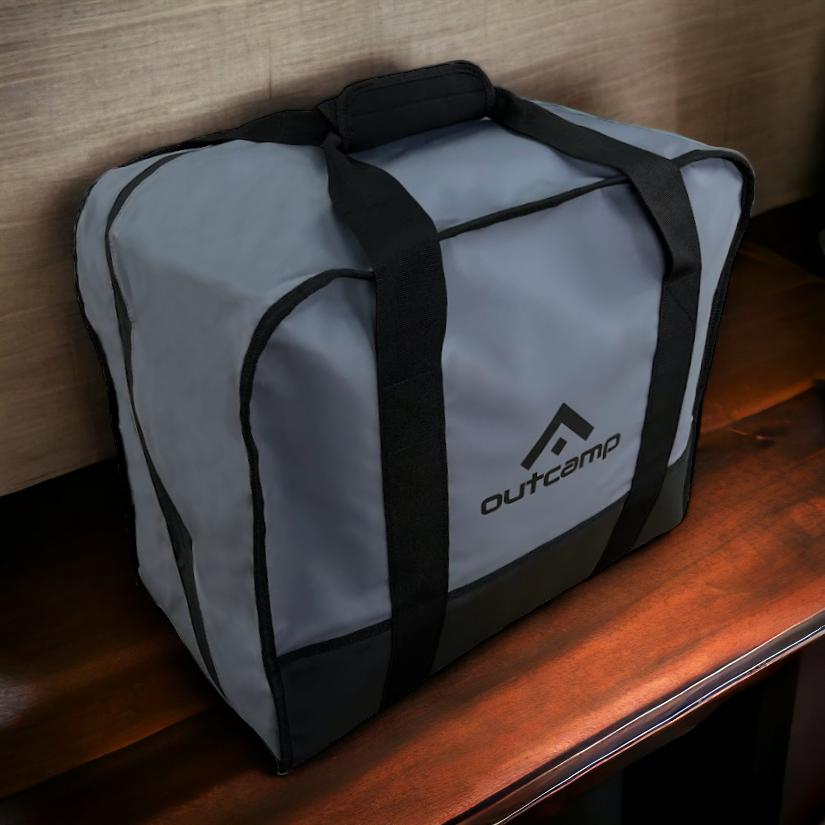
Outcamp's range of caravan accessories — including lightweight connectivity solutions, compact mounting systems, and practical organisational gear — is selected with weight-conscious tourers in mind. Keeping your connectivity setup light and compact means more payload budget for the things that really matter on extended Australian adventures.




Leave a comment (all fields required)