


For professional field geologists, environmental consultants, and land surveyors operating in remote Australia, equipment reliability is not merely a matter of convenience; it is a critical component of project viability and site safety. When your "office" is located four hundred kilometres from the nearest regional centre, at the end of a corrugated station track that has not seen a grader in three years, every piece of technology you carry must be capable of surviving the journey. The introduction of the Starlink Mini has revolutionised how these professionals access real-time data and maintain communication, but the hardware itself remains a sensitive electronic asset that requires a level of protection commensurate with its value to the operation. This is why the Starlink Mini hard case has become a standard requirement for remote field teams.
The primary challenge of remote field work is the sheer hostility of the environment. Fine red dust has a way of penetrating even the most sophisticated seals, while the constant, high-frequency vibration of a 4WD tray can rattle the internal components of unprotected electronics to the point of failure. If your primary communication link goes down due to physical damage or environmental ingress, the cost of the resulting downtime—measured in lost billable hours, delayed reporting, and potential safety risks—can easily exceed the initial cost of the hardware ten times over. This is where a professional-grade Starlink Mini hard case transitions from an optional accessory to a mandatory piece of site equipment.
Protecting Assets in the Corridor: The High Cost of Equipment Failure and why you need a Starlink Mini Hard Case
In the professional surveying and exploration sectors, the transition to Industry 4.0 has made real-time connectivity a baseline requirement. Geologists now use high-resolution mapping software that syncs to cloud-based geological databases, while surveyors rely on NTRIP corrections and GNSS data streams that require consistent, low-latency internet. When a surveyor is on a ten-day stint in the Pilbara or the Goldfields, a cracked dish face or a damaged connector port on their Starlink Mini does not just mean they cannot check their emails in the evening; it means the entire data workflow for the project is compromised.
The Impact of Vibration and Corrugations
Australian unsealed roads are notorious for their ability to destroy equipment. Corrugations create a specific type of mechanical stress known as harmonic vibration, which can be devastating for electronic devices that are loose in a vehicle cabin or stored in a soft-sided bag. Over hundreds of kilometres, this vibration can fatigue soldering points, loosen internal connectors, and cause micro-cracks in the circuit boards of the Starlink Mini.
Utilising a Starlink Mini hard case provides a rigid exoskeleton that isolates the hardware from these external forces. The custom-cut high-density foam interior ensures that the dish, the integrated kickstand, and the cabling are held securely in place, preventing any internal movement. By dampening the transfer of kinetic energy from the vehicle's chassis to the electronic hardware, the hard case significantly extends the operational lifespan of the unit in high-intensity touring environments.
Dust Ingress and Connector Integrity
Outback dust is not like city dust; it is a fine, abrasive, and often slightly magnetic particulate that can find its way into every crevice of a field vehicle. For the Starlink Mini, the primary vulnerability points are the power and Ethernet ports. While the unit itself carries an IP67 rating when properly sealed, the physical abrasive action of dust on the connectors during transit can cause premature wear on the pins and locking mechanisms.
The Starlink Mini hard case features a robust O-ring seal that creates a completely airtight and dustproof environment when closed. This ensures that the hardware arrives at the site in the same condition it left the depot, with clean ports and a clear face. For operators who require even more comprehensive protection, the Starlink Mini Explorer Bundle Pack often includes this level of hard-shell security as standard, recognising that the "bundled" approach to field gear is the most efficient way to manage asset integrity.
Thermal Management and UV Protection
While the Starlink Mini is designed to operate in temperatures up to fifty degrees Celsius, storing the unit in a direct sunlight-exposed vehicle cabin during transit can lead to heat soak. Passive thermal protection is a key benefit of a light-coloured or thermally stable hard case. By providing an insulated barrier, the case prevents the dish from reaching extreme temperatures before it is even powered on, ensuring that the hardware is ready for immediate deployment without thermal throttling.
Furthermore, constant exposure to UV radiation during transport—common for gear that is simply thrown onto a back seat or a dashboard—can eventually degrade the plastics used in modern electronic casings. A dedicated hard case provides absolute UV protection during the ninety-five per cent of the time the unit is in transit rather than in active service. This preserving of the structural integrity of the outer casing is essential for maintaining the long-term water-resistance of the dish.
Anatomy of the Starlink Mini Hard Protective Travel Case
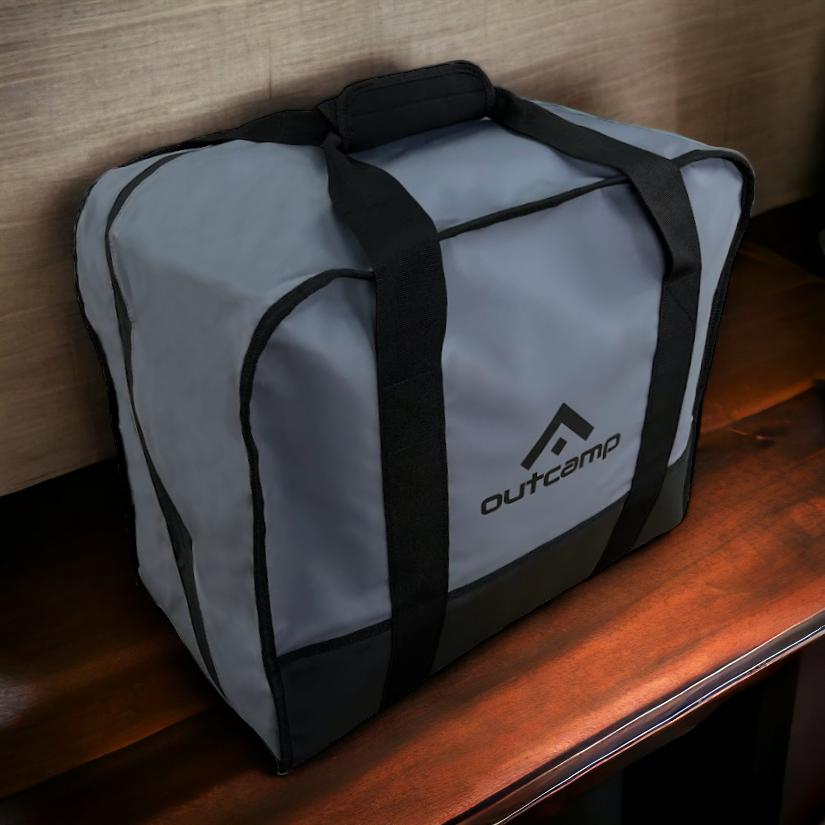
Not all hard cases are created equal, and for professional applications, the difference between a generic plastic box and a precision-engineered protection system is significant. The Starlink Mini hard case offered by Outcamp has been specifically selected and tested to meet the requirements of Australian commercial operators. From the composition of the outer shell to the specific density of the foam, every element is designed to serve a functional purpose in a high-consequence work environment.
Engineered Shell and Latches
The outer shell of the case is constructed from a high-impact polypropylene copolymer that balances rigidity with energy-absorption. This material is designed to flex slightly upon impact, dissipating the force around the perimeter of the case rather than transferring it directly to the contents. This is particularly important for gear that may be dropped from a tailgate or subjected to shifting loads in a canopy during sudden braking.
The latching system is equally critical. Professional operators require latches that are easy to operate with gloved hands but are secure enough to stay closed even if the case is dropped. The dual-stage power latches used on our hard cases provide a high degree of leverage to compress the O-ring seal, ensuring the airtight integrity of the case is maintained throughout the life of the product. An integrated pressure equalisation valve allows for easy opening after changes in altitude or temperature, which is a common occurrence for equipment being flown to remote sites on charter aircraft.
Custom-Cut Internal Architecture
The true value of a professional Starlink Mini hard case lies in its internal layout. Unlike "pick-and-pluck" foam which can degrade and shed particulates over time, our cases utilize a precision CNC-milled high-density foam. This foam is non-abrasive and closed-cell, meaning it will not absorb moisture or oils that could damage the finish of the Starlink dish.
The layout includes dedicated cavities for the Starlink Mini dish, the power supply, and up to ten metres of cabling. This organisation is not just about protection; it is about accountability. When a field crew is packing up at the end of a long day, the custom foam provides an immediate visual check that all components are present and accounted for. There is a designated spot for everything, including auxiliary power options like the PeakDo LinkPower 2 Portable Power Bank (99Wh), ensuring that the entire connectivity kit is stored as a single, deployable unit.
"In the remote sector, the goal is to reduce variables. A piece of gear that is stored in a dedicated hard case is a known quantity—it is protected, it is complete, and it is ready to work the second you open the lid. That certainty is worth its weight in gold when you are three days from the nearest spare part."
Rapid Deployment and Workflow Optimization
Efficiency in the field is driven by the speed at which a team can transition from "transit" to "operational." For a geologist arriving at a new outcrop or a surveyor setting up a temporary base station, every minute spent untangling cables or searching for mounts is a minute of lost productivity. A well-organised Starlink Mini hard case is the foundation of a rapid-deployment workflow.
The "Office in a Box" Concept
By housing the Starlink Mini, its power supplies, and mounting accessories in a single case, operators create a portable office that can be moved from vehicle to vehicle or from vehicle to site office in seconds. This mobility is essential for project managers who may be moving between different sections of a large-scale infrastructure corridor or mining lease.
The case can be configured to hold a Starlink Mini Portable Magnetic Roof Mount, allowing the operator to go from opening the case to having a live satellite link on the vehicle roof in under two minutes. This "plug-and-play" capability is only possible when the gear is stored in a way that respects the workflow of the professional user. By minimising the friction of setup and teardown, the hard case encourages more frequent use of the technology, leading to better data capture and more consistent communication.
Flight Compliance and FIFO Logistics
For FIFO (Fly-In Fly-Out) workers, equipment must be transportable on regional charter flights or commercial airlines. The Starlink Mini hard case is sized to meet most airline carry-on or checked baggage requirements, and the integrated TSA-compliant lock holes provide an added layer of security for high-value assets.
When travelling with the PeakDo LinkPower 2 Portable Power Bank (99Wh), which is specifically designed to be under the 100Wh airline limit, the entire kit can often be carried onto the aircraft. Having your primary communication tool in a rugged, manageable case makes the transition through airports and onto site transport significantly smoother, reducing the risk of gear being misplaced or damaged by baggage handlers.
Enhancing Site Safety and Compliance
From a WHS (Work Health and Safety) perspective, managing field equipment effectively reduces site clutter and trip hazards. A dedicated case keeps cables neatly coiled and hardware off the ground, where it could be stepped on or driven over. Furthermore, by ensuring that the Starlink Mini is always operational and protected, the case indirectly supports the site's emergency communication plan.
Many remote sites now mandate that every vehicle has a primary and secondary means of communication. By protecting the Starlink Mini in a hard case, you are ensuring that your high-speed satellite link is always available as part of your safety redundant stack. In the event of a vehicle breakdown or a medical emergency, the ability to rapidly deploy a reliable internet connection for VOIP calls or data transmission can be lifesaving.
Frequently Asked Questions
Can the Starlink Mini Hard Case be mounted externally?
The Starlink Mini hard case is designed for the protection and transit of the hardware rather than permanent external mounting. While the case itself is highly weather-resistant and dustproof, it is intended to be stored within a vehicle cabin, a canopy, or a storage box during transit. For permanent or semi-permanent external mounting of the dish itself, we recommend using the Starlink Mini Portable Magnetic Roof Mount or the Starlink Mini Roof Rack Mount, which are engineered to hold the dish securely while in motion.
Does the custom foam shed dust or particles onto the dish?
No, the professional-grade cases utilise high-density, closed-cell foam that is specifically chosen for its durability and cleanliness. Unlike lower-quality foams that can crumble or "flake" over time, this foam maintains its structural integrity through thousands of cycles of use. This ensures that the sensitive face of your Starlink Mini remains clear of debris and scratches, maintaining optimal signal performance.
Is the hard case compatible with third-party power supplies?
The internal foam is precision-cut to fit the standard Starlink Mini dish and the official power accessories. However, the modular nature of the layout often allows for the storage of compact third-party accessories. There is typically enough space within the cable management sections to house a PeakDo LinkPower 2 Portable Power Bank (99Wh) or compact 12V adapters. For large, non-standard power systems, we recommend checking the internal dimensions of the case against your specific hardware.
Conclusion: Investing in Asset Longevity with a Starlink Mini Hard Case
The Starlink Mini is perhaps the most significant advancement in remote communications technology of the last decade, but like any precision tool, its effectiveness is dependent on how well it is maintained. For the professional operating in the Australian outback, the environment is a constant threat to hardware integrity. Corrugations, dust, heat, and the rigours of frequent transport all work together to accelerate the failure of unprotected electronics.
Investing in a Starlink Mini hard case is a decision grounded in professional risk management. It is about protecting the initial capital investment in the hardware, but more importantly, it is about protecting the continuity of your operations. By providing a secure, dustproof, and vibration-dampened home for your connectivity gear, you are ensuring that your mobile office is ready to perform the moment you arrive on site.
If you are outfitting a professional field team or preparing for an extended remote surveying project, explore our range of Starlink Mini Protective Carry Gear at Outcamp today. We build and source rugged accessories designed to survive the harshest conditions on the planet, so your team stays connected, no matter how far they are from the nearest mobile tower.




Leave a comment (all fields required)