


Camp Kitchen Setup: The Best Portable Cooking Gear for Australian Campers in 2026
A good camp kitchen setup is one of those things that quietly transforms your trip. When you can cook a proper meal at the end of a long day on the track — without wrestling with a wobbly two-burner on the tailgate or burning everything because your pan doesn't sit level — everything feels better. Camping food doesn't have to mean baked beans and instant noodles, and in 2026, the gear available to Australian campers makes genuinely good outdoor cooking not just possible but straightforward.
Whether you're doing weekend trips out of the back of a 4x4, cooking for a family of four from a caravan annexe, or going ultralight on a multi-day hike and carrying everything on your back, there's a camp kitchen configuration that suits your style. This guide covers the core components — camp stoves, cookware, fridge and food storage, water systems, and the organisational setup that ties it all together.
Choosing the Right Camp Stove for Australian Conditions
The stove is the heart of any camp kitchen. Choose wrong and you'll be fighting wind, struggling with uneven heat, or running out of fuel in inconvenient locations. The right choice depends on your trip style: how many people you're cooking for, what fuel you can reliably source or carry, and how much space and weight you can afford to dedicate to cooking equipment.
Australian campers are broadly divided between gas stove users and those who cook on coals or wood, with a growing number adding portable induction cooktops to their 12V-powered camp kitchens. Each approach has clear strengths and practical limitations, and understanding those tradeoffs makes the buying decision much more straightforward.
Two-Burner Gas Stoves
The two-burner camp stove remains the most versatile option for most Australian campers. Quality units from Primus, Camp Chef, and Coleman offer good heat output — typically 6,000–9,000 BTU per burner — with reliable ignition and solid wind resistance when used with the built-in windshields most current models include. The Primus Kamoto Open Fire range and Camp Chef Explorer are consistently praised in the Australian camping community for build quality that holds up over years of hard use.
Fuel access is the key practical consideration for remote touring. Screw-top Lindal valve gas cartridges (the 100g, 230g, and 450g sizes) are widely available throughout Australia but can be hard to source in genuinely remote locations. A stove that runs on both cartridges and LPG via an adaptor hose gives you flexibility — you can top up from your caravan's gas bottle when cartridges run out, and fall back to cartridges in the field. This dual-fuel flexibility is worth seeking out for anyone doing extended remote trips.
Camp Ovens and Coals Cooking
Camp oven cooking — slow cooking in a heavy cast iron Dutch oven over coals — produces food that no gas stove can match. Slow-cooked lamb, beef stews, bread, and desserts that spend two hours in a camp oven have a depth of flavour that justifies the weight and the learning curve involved. Australian bush cooking culture has a long tradition here, and for good reason.
The tradeoff is time and fuel management. Coal cooking requires adequate firewood or heat beads (charcoal briquettes work well and give consistent temperatures), and you need to plan meals 2–3 hours in advance rather than 20 minutes. For camps where you're staying multiple nights and have the time to invest, camp oven cooking is deeply satisfying. For camps where you're arriving late and leaving early, a gas stove is more practical.
Cast iron camp ovens from Hillbilly, Camp Chef, and Lodge are the standard in Australia, in sizes ranging from the 4-quart that suits 2–3 people to the 12-quart size that comfortably feeds eight. Season your camp oven properly, cook with it regularly, and it will last a lifetime. The Hillbilly 10-inch and 12-inch versions are particularly popular among Australian 4x4 campers for the combination of capacity and durability.
Portable Gas BBQs
For many Australian campers, a compact gas BBQ is as important as a stove. Weber's Baby Q range — the Q1200 and the Q2200 for groups — has built a devoted following for good reason: they're well-made, produce genuine BBQ heat, clean up easily, and run on standard LPG bottles or cartridge adaptors. The Baby Q fits neatly into a 4x4 canopy or caravan storage and weighs around 11–14 kg depending on model.
Alternatives like the Ziggy portable BBQ and the Ziegler & Brown Twin Burner offer more cooking surface and some additional versatility, though at greater size and weight. If your camp cooking is heavily oriented towards grilling — fish, steak, sausages, vegetables — a dedicated portable BBQ is worth the storage space. If you primarily cook in pots and pans, a good two-burner stove serves you better and takes up less room.
Camp Cookware: What to Carry and What to Leave at Home
Camp cookware selection is where experienced campers diverge most significantly from beginners. Beginners buy cheap non-stick sets that scratch and warp within a season. Experienced campers work out exactly what they actually cook and carry only what serves those meals — usually far less than they started with.
The fundamental question is whether to go hard-anodised aluminium, stainless steel, or cast iron. Each has a role, and most serious camp cooks end up with a combination rather than committing entirely to one material.
Hard-Anodised Aluminium Cookware
Hard-anodised aluminium is the practical workhorse for camp cooking. It heats evenly and quickly, handles camp stove output well, weighs significantly less than stainless or cast iron, and holds up to hard use if you buy quality. MSR, Sea to Summit, and Primus all produce excellent hard-anodised camp cookware that performs reliably after years of use.
The MSR Base 2 Pot Set is a favourite among Australian campers who want compact, lightweight cookware for 2-person use. For larger groups, a 4-litre pot and a flat-bottomed frying pan cover most camp cooking scenarios — a pasta, a curry, eggs in the morning, and enough surface area for everything in between. Avoid buying large cookware sets with six or eight pieces: most of those pieces will sit unused in storage, adding weight and taking up valuable space.
Stainless Steel for Durability
Stainless steel cookware is heavier than aluminium but virtually indestructible, and it doesn't require any seasoning or special care beyond washing. For camp situations where cookware is regularly packed rough, dropped, or subjected to open flame, stainless is more durable. Stanley, GSI Outdoors, and Sea to Summit all produce quality stainless camp cookware that survives years of demanding use.
The tradeoff with stainless is heat distribution: thin stainless conducts heat unevenly, which means hot spots and burning if you don't manage the flame carefully. Tri-ply or multi-clad stainless — with an aluminium core layer — addresses this but adds cost. For boiling water and cooking stews or soups where even heat isn't critical, plain stainless is perfectly adequate. For frying and anything that needs even heat across the cooking surface, aluminium or cast iron serves you better.
Cutting Boards, Utensils and Organisation
A quality flexible plastic cutting board — thin, light, and easy to clean — is one of the most-used items in any camp kitchen and one of the most neglected when buying gear. Get two: one for meat, one for vegetables. Joseph Joseph and OXO make good options that pack flat and won't harbour bacteria in scratches the way cheap boards do.
For utensils, a silicone spatula, a long-handled spoon, tongs, and a sharp folding knife cover most camp cooking scenarios. The Victorinox Fibrox range produces excellent knives at reasonable prices that hold a good edge and are simple to maintain. A knife roll or hard case keeps your knives protected in transit — a loose sharp knife in a cookware box is a good way to cut yourself rummaging around at a campsite.
Camp Fridges and Food Storage
A quality 12V compressor fridge is one of the most impactful upgrades you can make to a camp kitchen setup. The difference between having cold drinks, fresh food, and proper ingredients versus relying on an ice box that goes warm by day two is enormous. If you have a second battery and a solar system, a 12V fridge is something you'll wonder how you ever camped without.
The Australian camping fridge market is dominated by Engel, National Luna, ARB Elements, and Evakool — all brands with long track records in the Australian market and proper engineering for our conditions. Fridge selection comes down to capacity, current draw, and price. A 40-litre fridge suits two people for a week, a 60-litre suits two for two weeks or a family of four for a week, and an 80-litre or dual-zone fridge gives you the flexibility to run a separate freezer compartment for ice cream, frozen meat, and cold packs.
Matching Fridge Size to Your Power Budget
A typical 12V compressor fridge draws 2–4 amps at steady state, translating to 50–100 Ah per 24-hour period depending on ambient temperature and how often the lid is opened. In hot Australian summer conditions — 35°C ambient with regular lid opening — draw sits toward the top of that range. In cooler conditions, it drops significantly. Factor your fridge's power draw prominently into your solar and battery sizing, because it's typically the largest single consumer in a camp setup.
Fridge placement matters too. A fridge in direct sun on a 40°C day works far harder than one parked in shade. Wherever your rig's fridge lives, adequate ventilation around it and shade where possible meaningfully extends its running time on a given battery charge. Insulated fridge covers are available for most popular models and reduce thermal load substantially, extending battery life and reducing compressor wear.
Camp Kitchen Organisation Systems
A well-organised camp kitchen speeds up every meal and reduces the frustration of hunting for things in the dark. Modular kitchen boxes or roll-up kitchen organiser systems let you pack everything in a structured way so you always know where each item lives. The Pelican 1510 or similar hard cases work well for fragile items and spice kits. Canvas roll-up organisers are lighter and more flexible for utensils, cleaning gear, and condiments.
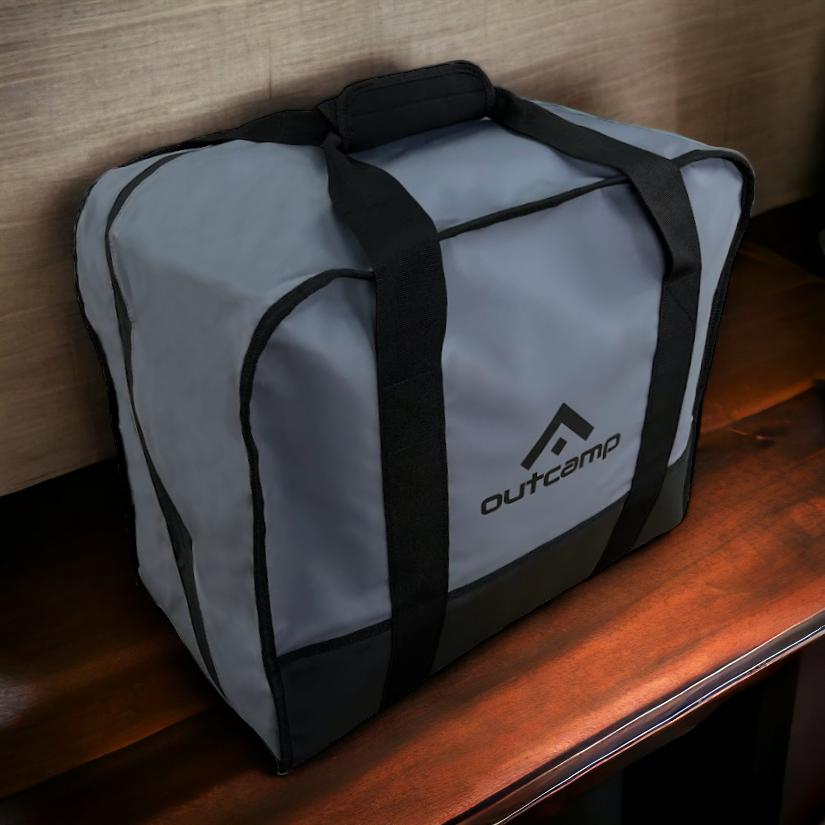
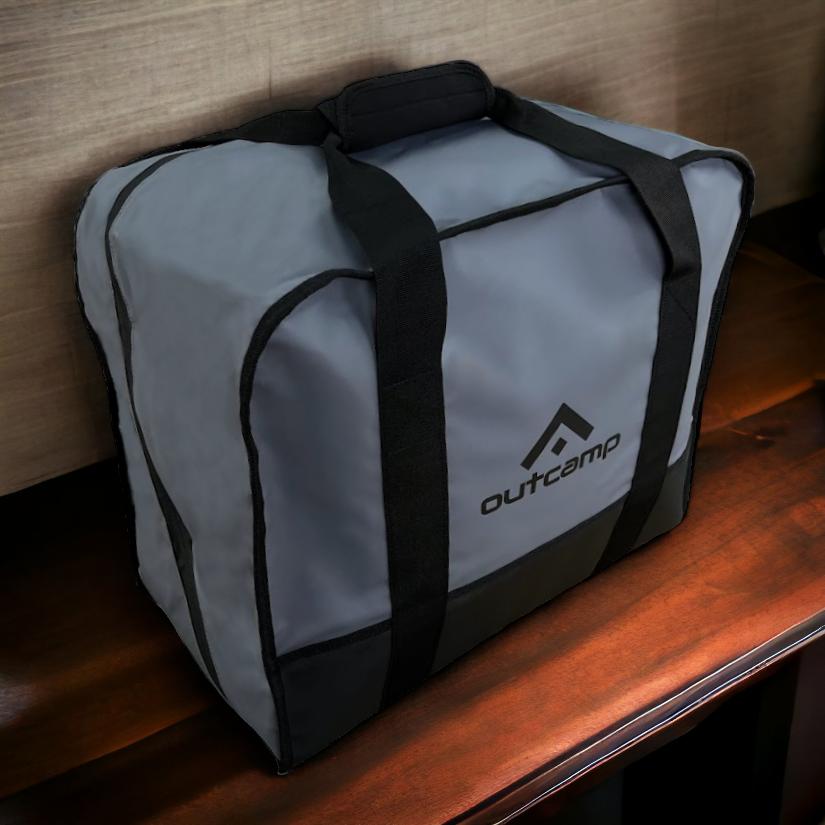
Outcamp's range of carry solutions and organiser bags are worth considering for camp kitchen applications — purpose-built storage for the gear that needs protecting in transit, in sizes that fit sensibly into canopy drawers and caravan storage compartments. A well-planned camp kitchen is one that works without thinking — everything in its place, accessible in the dark, and ready to produce a proper meal after a full day in the Australian bush.




Leave a comment (all fields required)