


Starlink Mini for Australian Oil and Gas: Backup Connectivity for Offshore Platforms, Pipelines and Remote Wellheads
Australia's oil and gas sector runs on data. Every barrel pumped, every cubic metre of LNG chilled and shipped, every safety-critical valve actuated from a control room hundreds of kilometres away depends on reliable connectivity between assets, crews and head office. Yet the industry operates in some of the most connectivity-hostile environments on the continent — offshore platforms in the Bass Strait and the North West Shelf, gathering systems threading through the Cooper and Surat basins, remote wellheads tucked into the Pilbara, and crew transports moving between drill rigs along corridors where mobile coverage drops out for hours at a time.
Starlink Mini is changing the calculus. Compact enough to mount on a ute or a workboat, rugged enough to survive a Pilbara summer, and fast enough to carry SCADA telemetry, video feeds and crew welfare traffic side by side, the Mini gives oil and gas operators a serious option for backup connectivity, mobile crew comms, and primary links at smaller satellite sites where running fibre or microwave is simply not commercial. Paired with the right mount, power supply and protective gear, it becomes a deployable communications asset that pays for itself the first time a primary link drops out during a critical operation.
The Connectivity Challenge in Australian Oil and Gas
Australian oil and gas assets are spread across a continent. Major LNG operations cluster around Karratha, Darwin, Gladstone and the Bass Strait, but the upstream footprint extends through the Cooper Basin in central Australia, the Surat and Bowen Basins in Queensland, the Otway and Gippsland in Victoria, and the unconventional gas plays of the Beetaloo and Canning Basins. Each of these regions presents a different connectivity profile, but they share a common problem: distance from terrestrial fibre and the inherent fragility of microwave and HF links.
For decades, operators have stitched together connectivity using a layered approach — fibre to control rooms, microwave shots between platforms or between wellheads and gathering stations, VSAT for redundancy, mobile networks where they reach, and satellite phones as the last resort. This stack works, but it is expensive, slow to deploy and difficult to extend to mobile assets. Starlink Mini does not replace the entire stack, but it dramatically simplifies the parts of it that are hardest and most expensive: the long tail of remote sites, the temporary deployments, and the mobile crews.
Offshore platforms and the limits of microwave links
Offshore platforms in the North West Shelf and Bass Strait have traditionally relied on a combination of microwave links to shore and geostationary VSAT for redundancy. Microwave is fast and low latency but vulnerable to weather and to the geometry of the platform itself. Geostationary VSAT is reliable but slow, with latency in the 600 millisecond range that makes it unusable for modern collaboration tools, video conferencing or real-time control. When the primary microwave link drops in a storm, crews are left with degraded comms at exactly the moment they need bandwidth most.
Starlink Mini, with its low earth orbit constellation and 30 to 50 millisecond latency, slots into this environment as a third leg. It is not designed to be the primary link on a major platform, but it provides a fast, low-latency backup that lets supervisory operations, video calls with onshore engineers, and crew welfare traffic continue uninterrupted when the microwave is down. For smaller offshore assets — unmanned wellhead platforms, FPSOs without dedicated VSAT capacity, supply vessels and crew transfer boats — it can serve as the primary link.
The Mini's small form factor is a particular advantage offshore. It can be mounted on a railing, deployed temporarily during a maintenance campaign, or carried out to an unmanned platform inside a hard case for spot use. With the Starlink Mini Marine Rail Mount (25-32mm) it can be fixed to standard handrails, and the Starlink Mini Hard Protective Travel Case keeps it safe through helicopter transfers and crane lifts.
Pipelines that run thousands of kilometres
Australian gas pipelines are long. The Moomba to Sydney pipeline runs more than 2,000 kilometres. The Northern Gas Pipeline links Tennant Creek to Mount Isa across some of the most remote country in the world. Pipelines need monitoring at every block valve station, every compressor, every metering point, and every cathodic protection rectifier. Traditionally this has meant running fibre alongside the pipeline — expensive but reliable — or relying on mobile networks where they exist and falling back to satellite at the gaps.
Starlink Mini changes the economics for the gaps. A small site that needs to push a few megabytes of telemetry per day, occasional video from a security camera, and the ability to host a tablet for an inspection technician can be served by a single Mini installation for a fraction of the cost of a full VSAT installation. For pipelines under construction, where temporary connectivity is needed at survey camps and welding spreads that move every few weeks, the Mini's portability is transformative.
Inspection crews travelling the pipeline in vehicles also benefit. Mounting a Mini on a ute roof rack with the Starlink Mini Roof Rack Mount, powering it from the vehicle's 12V system using the Starlink Mini 12V to 24V Power Supply (Anderson Plug), means the inspection vehicle becomes a connected node — uploading drone footage, syncing inspection forms to the asset register, and giving the crew the ability to consult head office without driving to the next town.
Onshore basins and unconventional gas sites
The unconventional gas operations in the Surat, Cooper and Beetaloo basins involve hundreds of small wellheads, gas gathering systems, and water management facilities spread across vast pastoral leases. Each site needs connectivity for SCADA, security cameras, environmental monitoring and the periodic visits of maintenance crews. Mobile coverage in these areas is patchy at best — Telstra's network reaches major roads and towns, but most wellpads sit well outside coverage.
For these sites, Starlink Mini is often a better fit than fixed Starlink Gen 3 dishes. The Mini consumes less power, handles vibration and dust better, and is easier to deploy on a small mast or skid. With the Starlink Mini Agricultural Mount (25-32mm rail) it bolts directly to standard pipe railings on a wellhead manifold, and a Starlink Mini Portable UPS Power Supply (7-10 Hours) can keep it running through the brief outages that small solar-and-battery sites occasionally suffer.
For exploration and appraisal campaigns — where a drill rig sits at one location for a few weeks then moves to the next — the Mini is a natural fit. It is fast to set up, easy to relocate, and the running costs are predictable. Crews can run a full digital workflow including real-time mud logging data, video calls with the geology team in Brisbane or Perth, and welfare comms back to families.
How Starlink Mini Delivers for Oil and Gas Operations
The reason Starlink Mini has been adopted so quickly across remote Australian industries is not just availability — it is the combination of throughput, latency and reliability that the LEO constellation provides. For an industry that has historically traded performance for reliability when choosing satellite links, the Mini removes the trade-off. You can run business-grade applications without compromise, and you can do it from places where no other option exists.
Below are the three operational characteristics that matter most for oil and gas, and how Starlink Mini measures up against the alternatives operators have been forced to use.
Throughput and latency for industrial applications
Modern oil and gas operations push a lot of data. A single high-resolution security camera can generate 5 to 10 gigabytes per day. Vibration sensors on rotating equipment, pressure transmitters on pipelines, and gas detectors at processing facilities all add to the load. Then there is the human side — video calls between site and head office, large CAD model syncs, software updates pushed to industrial control systems during maintenance windows.
Starlink Mini delivers download speeds in the 100 to 200 Mbps range and uploads commonly in the 10 to 30 Mbps range. That is enough to handle a small site's full data load with margin, and it is enough for a crew of five or six to run simultaneous video calls without anyone dropping. Latency in the 30 to 50 millisecond range means SCADA polling cycles look local, and remote support sessions feel instantaneous rather than the laggy experience that geostationary VSAT delivers.
For sites running real-time control or remote operations centres, latency is the deciding factor. A control engineer in Perth supervising a wellhead in the Beetaloo cannot work effectively over a 600 ms link — the round trip on every command makes operations unsafe. With Starlink Mini, that gap closes to the point where remote supervisory operations are practical, opening the door to the kind of centralised operating models that the majors have been pursuing for years.
Resilience as a backup or primary link
Oil and gas sites are designed for redundancy. No serious operator runs critical comms on a single link. Starlink Mini fits naturally into this philosophy because it is fundamentally diverse from terrestrial alternatives. A storm that knocks out a microwave link will not affect Starlink. A fibre cut on the only road to site does not matter. A mobile network outage caused by a backhaul failure has no bearing on the LEO constellation.
This diversity is what makes the Mini valuable as a backup even at sites that already have good primary connectivity. The cost of a Mini and a year of service is low compared to the consequences of a comms outage during a critical operation — a startup, a shutdown, a major maintenance turnaround, or an emergency response. For sites that do not justify a full VSAT redundancy installation, the Mini provides a credible second link at a fraction of the capex.
For sites that do not have any primary connectivity beyond mobile, the Mini becomes the primary link. Many smaller wellpads, water treatment facilities, and ancillary infrastructure fall into this category. Replacing a flaky 4G connection with a Mini transforms what is possible from those sites — proper SCADA polling, video security, environmental monitoring with cloud upload, and a reliable comms path for visiting crews.
Mobility for crews and equipment
Oil and gas does not happen at one location. Crews move between sites, drilling rigs migrate, workover vans drive thousands of kilometres a year, and supply boats run the distance between port and platform. For these mobile assets, traditional satellite was a non-starter — VSAT requires a stationary alignment, and mobile VSAT is heavy, expensive and complex. Mobile networks fade in and out of coverage. Starlink Mini handles motion gracefully, and at a price point that lets operators put one in every vehicle that needs it.
For utes and light trucks, the Starlink Mini Sports Bar Ute Mount or the Starlink Mini Roof Rack Mount provides a clean, low-profile installation. For heavier rigid trucks and prime movers, the Starlink Mini BullBar/Railing Mount or the MagLock Pro Magnetic Vehicle Mount allows a Mini to be deployed without drilling into the vehicle. Powering options range from a simple Starlink Mini Cigarette Lighter Power Supply (165W USB-C) for a quick installation to a hardwired Starlink Mini Hardwire Power Cable (3.0M) for permanent fitments.
For workboats and crew transfer vessels, the Starlink Mini Marine Rail Mount (25-32mm) clamps to standard handrails, and the Starlink Mini Suction Mount provides a non-permanent option for vessels where drilling into the deck or superstructure is not allowed. With the Starlink Mini Dish Protector Shield, the unit is protected from spray and the salt environment that destroys most consumer electronics within months.
Mounting and Powering Starlink Mini in Industrial Environments
Hardware that survives a Pilbara summer or a Bass Strait winter is not the same hardware that survives a backyard. Industrial deployments need mounts that hold up under vibration, power supplies that handle the dirty 12V you find on most vehicles and at most off-grid sites, and protective gear that stops dust, salt and UV from killing the equipment over time. Outcamp's range was built for exactly these conditions.
Below is a practical guide to specifying mounts, power and protection for the three most common oil and gas deployment scenarios — vehicle-mounted, semi-permanent at a wellhead, and portable for project use.
Vehicle and vessel mounting for crew transport
The right mount depends on the vehicle. For utes used by inspection and maintenance crews, the Starlink Mini Roof Rack Mount fits standard load bars and provides a stable, clear sky view. The Starlink Mini Sports Bar Ute Mount works for vehicles with sports bars, putting the Mini in the airflow above the cab where it stays cool. For supervisor vehicles and rapid-response 4x4s where drilling is not an option, the MagLock Pro Magnetic Vehicle Mount uses heavy-duty magnets to grip the roof, with a tether for highway-speed insurance.
For vessels, the Starlink Mini Marine Rail Mount (25-32mm) is the workhorse, fitting standard handrails on workboats, supply vessels and crew transfer craft. Because salt and UV are merciless on plastic, the Starlink Mini Dish Protector Shield is essentially mandatory in marine use. Cabling should use marine-grade glands where it enters the vessel — the Waterproof DC Wall Socket Passthrough is purpose-built for this and stops water ingress at the bulkhead.
Cable routing matters more than people expect. A cleanly routed Starlink Mini Hardwire Power Cable (3.0M), secured with Magnetic Cable Tie Mounts, looks professional, survives vibration, and avoids the chafe failures that take out poorly installed systems within a year. For installations that need to disconnect quickly — a Mini that comes off the ute when the truck goes in for service — the Starlink Mini Anderson Plug to DC Power Cable (5.0M) is the industry-standard choice.
Permanent and semi-permanent installations at wellheads
For wellhead installations and small unmanned sites, the goal is a fit-and-forget setup that survives years of weather. The Starlink Mini Agricultural Mount (25-32mm rail) bolts to existing pipe railings on the manifold or on a small purpose-built mast. Heights of 2 to 4 metres are usually sufficient — the Mini's antenna pattern is wide enough that you do not need a 30-metre tower.
Power at unmanned sites is often solar-and-battery. The Mini's 25 to 40 watt steady draw is well within the budget of a 200 watt panel and a 100 amp-hour battery, but the supply needs to be clean. The Starlink Mini DC Power Converter (Anderson SB50) takes the dirty 12V or 24V output of a typical solar controller and delivers stable power to the Mini. For sites that occasionally lose battery for a few minutes during cloudy weather changeovers, the Starlink Mini Portable UPS Power Supply (7-10 Hours) covers the gap.
Where the site has shore power or generator power, the Starlink Mini 20V Hardwired Power Socket with Integrated Voltage Booster simplifies installation by accepting whatever is on hand and converting it cleanly. For sites with intermittent occupancy where the Mini only needs to run while crews are present, the Remote Control Operated 12V-24V Power Supply lets a passing crew turn the Mini on by remote rather than climbing the mast.
Powering Starlink Mini off-grid and off-platform
Field crews often need connectivity in places where there is no infrastructure at all — a survey camp, a temporary helipad, a watchpoint during a flaring operation. The Mini was designed for exactly this use case, and the Outcamp power range covers every option. The PeakDo LinkPower 2 Portable Power Bank (99Wh) gives a full work day of runtime in a unit small enough to carry in one hand, and it is airline compliant for crews that need to fly between sites with their kit.
For longer deployments, the Starlink Mini Makita 18V Battery Connector and the Starlink Mini Milwaukee 18V Battery Adapter let crews run the Mini directly from the cordless tool batteries they already carry. A standard 5 amp-hour Makita battery will run the Mini for several hours, and most crews carry six to ten batteries between the team. The PeakDo Power Dock for Makita extends this further with a docking station that swaps batteries automatically as they discharge.
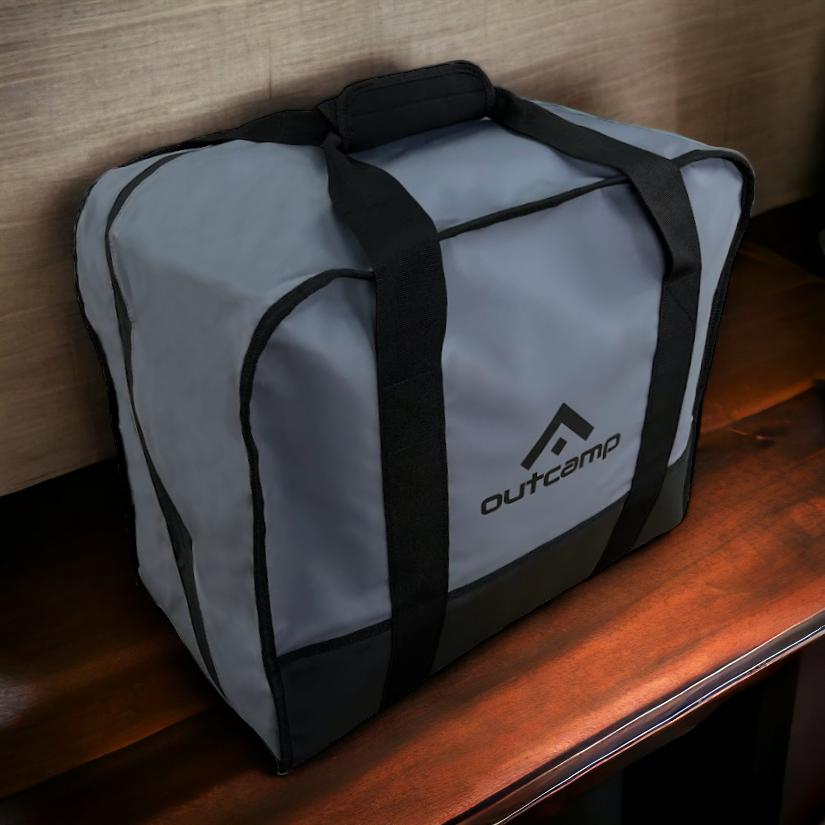
The Starlink Mini Explorer Bundle Pack consolidates the most useful accessories — bag, mount, cable, power — into a single kit that field crews can grab and go. For oil and gas operators looking to standardise their portable kit across drilling, completions, production and maintenance crews, the Explorer Bundle is a sensible starting point that can be supplemented with industry-specific extras as needed.
Building Starlink Mini Into Your Operating Model
The biggest mistake operators make with Starlink Mini is treating it as a consumer product that happens to work in industrial settings. It is more productive to think of the Mini as a deployable communications asset that fits into the existing operating model — a unit on every workover van, a spare in the warehouse for emergency response, a permanent install at every wellpad that does not justify the capex of a full VSAT. Specified properly with the right mounts, cables and power, the Mini becomes part of the standard fit-out rather than an ad-hoc add-on.
The total cost of ownership story is also strong. A typical Mini installation, including a marine-grade mount, hardwired power supply, protective case and cabling, sits well under the cost of a single month of geostationary VSAT service. Running costs are predictable. Maintenance is minimal. And the same hardware that runs your wellhead today can be redeployed to a survey camp or a workover rig tomorrow with no reconfiguration.
Outcamp's full range of Starlink Mini accessories is built for Australian conditions and is in stock with fast dispatch from Sunshine Coast operations. Whether you are specifying a fleet rollout for a major operator or fitting out a single appraisal rig for a small explorer, the right mount, power supply and protective gear are available off the shelf — and the team behind them understands the difference between weekend camping use and a 24/7 industrial deployment. Visit outcamp.com.au to specify your installation, or get in touch for advice on fleet-scale rollouts.




Leave a comment (all fields required)